ICTQual AB
ICTQual AB Welcome to ICTQual AB
Courses › Level 8 Professional Diploma in Health, Safety and Environmental Engineering

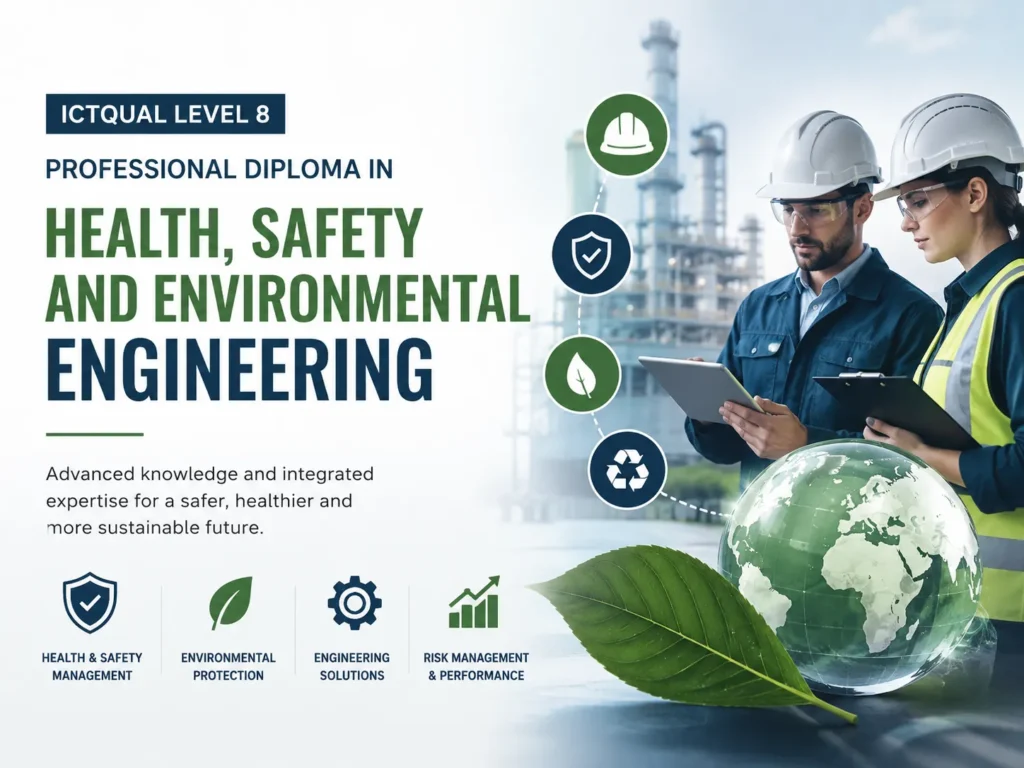
Level 8 Professional Diploma in Health, Safety and Environmental Engineering

The ICTQual Level 8 Professional Diploma in Health, Safety and Environmental Engineering provides advanced and integrated study across the interconnected disciplines of occupational health, safety engineering, environmental protection, risk management…

Advanced 60 weeks 9 lessons 35 quizzes
Overview
Curriculum 44
Instructor

What You Will Learn

This programme develops advanced knowledge and integrated understanding of health, safety and environmental engineering across complex technical and organisational environments.

  • Advanced HSE management systems and risk assessment
  • Hazard analysis and engineering controls
  • Occupational health and workplace exposure
  • Process safety, fire and emergency management
  • Incident investigation and root-cause analysis
  • Environmental management and sustainability
  • Safety performance and continual improvement
  • Human factors and safety culture
  • Emerging HSE technologies and engineering solutions
  • Advanced research, analysis and decision-making

The ICTQual Level 8 Professional Diploma in Health, Safety and Environmental Engineering provides advanced and integrated study across the interconnected disciplines of occupational health, safety engineering, environmental protection, risk management and engineering-based control. The programme examines how complex hazards, technological systems, human factors, organisational conditions and environmental pressures interact within high-risk and technically demanding environments. Its content extends beyond conventional compliance-oriented approaches by examining sophisticated methods for hazard analysis, risk assessment, safety management systems, engineering controls, process safety, emergency management, environmental risk, incident investigation, occupational health and emerging technologies. Particular emphasis is placed on understanding complex systems, evaluating competing approaches and applying technically sound reasoning to situations where risk, uncertainty, performance and sustainability must be considered together.

The programme develops an integrated understanding of how health, safety and environmental considerations influence engineering decisions, organisational resilience and long-term operational performance. It brings together scientific principles, engineering methodologies, analytical techniques, management frameworks and contemporary developments to examine increasingly complex challenges across modern industrial and built environments. The programme provides a rigorous foundation for interpreting evidence, evaluating risk-control strategies, understanding systemic causes of harm, assessing environmental consequences and developing informed approaches to complex HSE challenges. The overall emphasis is on depth of understanding, critical evaluation, technical reasoning and engagement with evolving challenges across health, safety and environmental engineering.

Requirements

Entry is intended for applicants with relevant advanced academic preparation in health, safety, environmental management or engineering, together with sufficient English proficiency for advanced study.

  • Level 7 Diploma in Occupational Health & Safety, Environmental Management, Engineering, or a closely related discipline.
  • Alternatively, a relevant Master’s Degree in Health & Safety, Environmental Science, Engineering, Industrial Safety, or another related field.
  • Sufficient English language proficiency to understand course materials, complete written work and participate in research activities.
Section 1: Unit No 1 : Health and Safety Management System (HSMS)
44 items
This unit examines advanced principles of Health and Safety Management Systems and their role in controlling risk across complex organisational and engineering environments. It explores the architecture, implementation and integration of internationally recognised management-system approaches, together with advanced hazard identification, risk assessment, hierarchy of controls and systematic methods for analysing complex sources of harm. The unit considers how hazardous substances, hazardous energy, electrical systems and other high-risk activities can be assessed and controlled through structured engineering and management approaches, while also examining incident investigation, root-cause analysis and the influence of organisational conditions on safety performance.nnThe unit further develops understanding of how HSMS effectiveness can be evaluated, strengthened and adapted as operational conditions evolve. It considers management of change, safety performance indicators, monitoring and continual improvement, alongside emerging technologies and data-driven approaches that are transforming safety management. Particular attention is given to the interaction between technical controls, organisational systems, human factors and decision-making, providing a comprehensive perspective on how resilient safety systems can be developed and maintained within increasingly complex and technology-driven environments.
Lesson No 1 : Develop a comprehensive understanding of internationally recognized Health and Safety Management Systems (HSMS) such as ISO 45001 and ANSI Z10, and their role in designing effective workplace safety programs.
Quiz No 1 : Principles, Structure and Requirements of Internationally Recognised Health and Safety Management Systems
Quiz
Quiz No 2 : HSMS Frameworks and Systematic Hazard Identification, Risk Assessment and Workplace Safety Management
Quiz
Quiz No 3 : Regulatory Compliance, Safety Culture and Continuous Improvement
Quiz
Quiz No 4 : Policy, Leadership Commitment and Operational Control
Quiz
Quiz No 5 : Designing Structured Workplace Safety Programmes Using HSMS Principles
Quiz
Lesson No 2 : Apply the hierarchy of hazard control measures to eliminate or minimize workplace risks and improve organizational safety performance.
Quiz No 1 : Principles and Levels of the Hierarchy of Hazard Control Measures
Quiz
Quiz No 2 : Workplace Hazards, Exposure Pathways and Risk Assessment
Quiz
Quiz No 3 : Evaluating the Effectiveness of Control Measures
Quiz
Quiz No 4 : Applying the Hierarchy to Develop Integrated Risk-Control Strategies
Quiz
Quiz No 5 : Recommending Hazard-Control Solutions to Improve Safety Performance
Quiz
Lesson No 3 : Utilize advanced hazard identification and risk analysis techniques, including Hazard Analysis, Failure Modes and Effects Analysis (FMEA), Fault Tree Analysis (FTA), Fishbone Analysis, What-If Analysis, Checklist Analysis, and Change Analysis.
Quiz No 1 : Principles, Methodologies and Applications of Advanced Hazard Identification and Risk Analysis
Quiz
Quiz No 2 : Structured Identification of Workplace Hazards
Quiz
Quiz No 3 : Failure Modes and Effects Analysis and Fault Tree Analysis for Failure and Consequence Evaluation
Quiz
Quiz No 4 : Root-Cause Analysis through Fishbone and Change Analysis
Quiz
Quiz No 5 : Evaluating Analysis Outcomes and Developing Effective Risk Controls
Quiz
Lesson No 4 : Apply risk assessment and risk matrix methodologies to evaluate, prioritize, and implement effective risk mitigation strategies.
Quiz No 1 : Principles and Methodologies of Risk Assessment and the Use of Risk Matrices in Occupational Health and Safety Management
Quiz
Quiz No 2 : Workplace Hazard Identification and Assessment of Likelihood and Severity Using Structured Risk Assessment Techniques
Quiz
Quiz No 3 : Application of Risk Matrices to Evaluate and Prioritise Risks
Quiz
Quiz No 4 : Analysis of Risk Assessment Outcomes and Determination of Appropriate Mitigation and Control Measures
Quiz
Quiz No 5 : Development of Effective Risk Mitigation Strategies to Reduce Identified Risks and Enhance Organisational Safety Performance
Quiz
Lesson No 5 : Implement the Globally Harmonized System of Classification and Labelling of Chemicals (GHS) to ensure proper chemical hazard communication and safe handling procedures.
Quiz No 1 : Explain the Principles, Structure, and Purpose of the Globally Harmonized System (GHS) for Chemical Classification and Hazard Communication
Quiz
Quiz No 2 : Identify Chemical Hazards Using GHS Classification Criteria, Including Physical, Health, and Environmental Hazards
Quiz
Quiz No 3 : Interpret GHS Labels, Pictograms, Hazard Statements, and Safety Data Sheets (SDS) to Determine Appropriate Safety Precautions
Quiz
Quiz No 4 : Apply GHS Requirements to Ensure Proper Labelling, Storage, and Handling of Hazardous Chemicals in the Workplace
Quiz
Quiz No 5 : Evaluate Workplace Chemical Safety Practices to Ensure Compliance with GHS Standards and Effective Hazard Communication
Quiz
Lesson No 6 : Design and implement hazardous energy control programs covering electrical, hydraulic, thermal, kinetic, mechanical, and magnetic energy sources.
Quiz No 1 : Explain the Principles and Requirements of Hazardous Energy Control Programmes for Managing Multiple Energy Sources in the Workplace
Quiz
Quiz No 2 : Identify Potential Hazards Associated with Electrical, Hydraulic, Thermal, Kinetic, Mechanical, and Magnetic Energy Sources
Quiz
Quiz No 3 : Analyse Workplace Processes to Determine Appropriate Energy Isolation and Control Measures
Quiz
Quiz No 4 : Develop Hazardous Energy Control Procedures, Including Lockout/Tagout Systems and Safe Work Practices
Quiz
Quiz No 5 : Implement and Evaluate Hazardous Energy Control Programmes to Ensure Effective Risk Reduction and Compliance with Relevant Safety Standards
Quiz
Lesson No 7 : Demonstrate an understanding of fundamental electrical safety principles, including Ohm’s Law, electrical power, impedance, resistance, circuits, and energy control.
Quiz No 1 : Explain the Fundamental Principles of Electrical Safety, Including Voltage, Current, Resistance, Impedance, and Electrical Circuits
Quiz
Quiz No 2 : Interpret Ohm’s Law and Electrical Power Relationships in Relation to Workplace Electrical Systems and Safety Considerations
Quiz
Quiz No 3 : Identify Potential Electrical Hazards Associated with Electrical Equipment, Circuits, and Energy Sources
Quiz
Quiz No 4 : Analyze the Role of Electrical Safety Controls and Protective Measures in Preventing Electrical Incidents and Injuries
Quiz
Quiz No 5 : Apply Fundamental Electrical Safety Principles to Support Safe Operation, Maintenance, and Energy Control Procedures in the Workplace
Quiz
Lesson No 8 : Lead and facilitate incident and accident investigations, including root cause analysis, identification of contributing factors, evidence collection, data analysis, and management of high-risk incidents.
Lesson No 9 : Understand and apply Management of Change (MOC) principles to ensure safe implementation of operational or organizational changes.

ictqualab.co.uk

Administrator

Level 8 Professional Diploma in Health, Safety and Environmental Engineering
£2,000.00
  • 60 weeks
  • 9 lessons
  • 35 quizzes
  • Lifetime access