ICTQual AB
ICTQual AB Welcome to ICTQual AB
Courses › ICTQual Level 3 Award in Falls Prevention Awareness Training

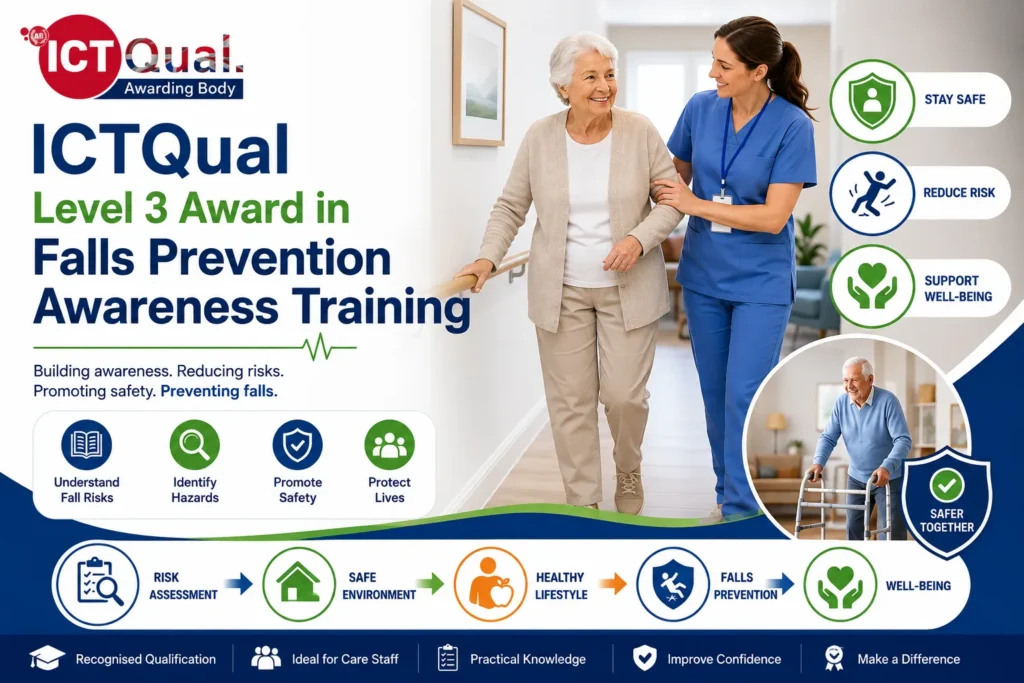
ICTQual Level 3 Award in Falls Prevention Awareness Training

The ICTQual Level 3 Award in Falls Prevention Awareness Training is a professionally developed qualification designed to provide learners with a comprehensive understanding of falls prevention within health and social…

Beginner 10 weeks 6 lessons 6 quizzes
Overview
Curriculum 12
Instructor

What You Will Learn

The ICTQual Level 3 Award in Falls Prevention Awareness Training provides learners with the essential knowledge and practical awareness required to identify, assess, and reduce the risk of falls in a wide range of health and social care environments. Throughout this qualification, learners will develop a clear understanding of the common causes of falls, the physical and environmental factors that contribute to fall-related incidents, and the impact falls can have on an individual's health, independence, confidence, and overall quality of life.

Learners will explore effective methods for recognising fall hazards, carrying out risk assessments, implementing preventive measures, and promoting safer care practices. The course also covers the importance of maintaining safe environments, supporting mobility, encouraging effective communication, and applying person-centred approaches when caring for individuals who may be at increased risk of falling.

In addition, learners will gain an understanding of the responsibilities of care professionals in reporting, documenting, and responding appropriately to fall incidents while following organisational policies and best practice guidelines. By the end of the qualification, learners will possess the confidence and practical awareness to contribute to safer workplaces, reduce fall-related risks, promote individual wellbeing, and support a positive culture of safety across healthcare, residential, community, and social care settings.

The ICTQual Level 3 Award in Falls Prevention Awareness Training is a professionally developed qualification designed to provide learners with a comprehensive understanding of falls prevention within health and social care settings. Falls remain one of the leading causes of injury, reduced independence, and hospital admissions among older adults and other vulnerable individuals. This qualification equips learners with the knowledge and practical awareness needed to recognise fall risks, understand their causes, and contribute to creating safer environments that support individual wellbeing.

The course explores the physical, environmental, behavioural, and organisational factors that increase the likelihood of falls while promoting a proactive approach to prevention. Learners develop an understanding of how effective risk identification, safe working practices, communication, and person-centred care can reduce incidents and improve health outcomes. The qualification also highlights the importance of maintaining dignity, independence, and quality of life for individuals who may be at greater risk of falling.

Designed in line with current professional practices and the evolving needs of the healthcare and social care sector, the ICTQual Level 3 Award in Falls Prevention Awareness Training is suitable for those working or intending to work in hospitals, residential care homes, nursing facilities, community care services, rehabilitation settings, and other care environments. It supports the development of essential competencies required to promote safer care and enhance organisational safety culture.

By combining evidence-informed principles with practical awareness, this qualification helps learners understand the significance of falls prevention as a key component of quality care. It provides a solid foundation for recognising potential hazards, implementing preventive measures, and supporting individuals through safe, effective, and compassionate care practices that contribute to improved wellbeing and reduced risk of fall-related injuries.

Requirements

  • Age: 16 years or above.
  • Educational Background: Basic secondary education or equivalent.
  • Experience: No prior experience required.
  • Language: Basic English reading, writing, speaking, and comprehension skills.
Section 1: Unit ni 1 : Understanding Falls and Their Impact
2 items
The ICTQual Level 3 Award in Falls Prevention Awareness Training provides learners with essential knowledge of falls prevention in health and social care settings. The qualification covers common causes of falls, risk factors, hazard identification, risk assessment, and practical prevention strategies. Learners also gain an understanding of safe working practices, person-centred care, incident reporting, and the importance of maintaining safe environments to reduce fall-related injuries. This course supports the development of professional awareness needed to improve safety, promote wellbeing, and contribute to high-quality care across healthcare, residential, and community care settings.
Lesson no 1 : Understanding Falls and Their Impact
Quiz no 1 : Understanding Falls and Their Impact
Quiz
Section 2: Unit no 2 : Risk Assessment and Screening
2 items
Risk assessment and screening are essential components of effective falls prevention, enabling healthcare professionals and care providers to identify individuals who may be at increased risk of falling before an incident occurs. A structured screening process involves collecting relevant information about a person's medical history, mobility, balance, medication use, vision, cognitive function, previous falls, and environmental hazards. Early identification of risk factors supports timely intervention, helping to reduce injuries, maintain independence, and improve overall wellbeing.nnA comprehensive risk assessment goes beyond simple observation by evaluating both intrinsic and extrinsic factors that contribute to falls. Intrinsic factors include age-related physiological changes, chronic health conditions, muscle weakness, impaired balance, and sensory deficits, while extrinsic factors include unsafe flooring, inadequate lighting, poor footwear, and environmental obstacles. Standardised assessment tools and evidence-based screening methods provide a consistent approach to identifying risk levels and prioritising appropriate care. Accurate documentation, regular reassessment, and multidisciplinary collaboration ensure that identified risks are effectively managed. By integrating systematic screening into routine care, organisations can strengthen patient safety, support person-centred care, minimise fall-related complications, and promote healthier, safer living environments for individuals across healthcare and community settings.
Lesson no 1 : Risk Assessment and Screening
Quiz no 1 : Risk Assessment and Screening
Quiz
Section 3: Unit no 3 : Prevention Strategies and Interventions
2 items
Prevention Strategies and Interventions focuses on practical approaches used to identify risks, reduce harm, and improve health, safety, and wellbeing outcomes. It includes early assessment, awareness initiatives, environmental improvements, and targeted actions designed to prevent avoidable issues.nnEffective interventions require evidence-based planning, collaboration, and regular evaluation to ensure successful outcomes. Understanding these strategies enables learners to apply appropriate preventive measures, support safer practices, and contribute to continuous improvement across professional and community settings.
Lesson no 1 : Prevention Strategies and Interventions
Quiz no 1 : Prevention Strategies and Interventions
Quiz
Section 4: Unit no 4 : Education and Empowerment
2 items
Education is the foundation of empowerment, providing learners with the knowledge, practical skills, and confidence needed to make informed decisions and achieve personal and professional success. It encourages critical thinking, lifelong learning, and equal opportunities while preparing individuals to adapt to changing social and economic environments.nnEmpowerment through education enables individuals to improve their quality of life, contribute to their communities, and support sustainable development. By promoting inclusion, innovation, leadership, and continuous learning, education creates stronger societies where people can realise their full potential and drive positive change for future generations.
Lesson no 1 :Education and Empowerment
Quiz no 1 :Education and Empowerment
Quiz
Section 5: Unit no 5 : Emergency Response and Post-Fall Management
2 items
Emergency Response and Post-Fall Management is an essential area of healthcare and social care, focusing on the immediate and appropriate actions required when a fall occurs. It covers emergency response, safety assessment, recognition of potential injuries, first aid, escalation of concerns, and appropriate communication with relevant healthcare professionals. Effective management helps protect individuals from further harm while ensuring that urgent risks are identified and addressed promptly.nnPost-fall management also involves appropriate assessment, monitoring, documentation, incident reporting, and follow-up care. Learners develop knowledge of how to respond calmly and systematically, support recovery, identify contributing factors, and apply measures that can reduce the likelihood of future falls. These principles support person-centred care, safer decision-making, effective risk management, teamwork, and continuous improvement across healthcare, social care, residential, and community care settings.
Lesson no 1 : Emergency Response and Post-Fall Management
Quiz no 1 : Emergency Response and Post-Fall Management
Quiz
Section 6: Unit no 6 : Ethical and Legal Considerations
2 items
Ethical and Legal Considerations are essential for promoting safe, respectful and accountable healthcare and social care practice. This topic explores confidentiality, consent, dignity, safeguarding, duty of care and professional responsibilities when supporting individuals at risk of falls.nnLearners will understand how ethical and legal principles guide decision-making, incident reporting and person-centred care. The topic also highlights the importance of balancing individual independence with safety, maintaining professional boundaries and following relevant UK legislation, organisational policies and procedures to protect individuals from harm.
Lesson no 1 : Ethical and Legal Considerations
Quiz no 1 : Ethical and Legal Considerations
Quiz

Arshad Hussain

Instructor

ICTQual Level 3 Award in Falls Prevention Awareness Training
£550.00
  • 10 weeks
  • 6 lessons
  • 6 quizzes
  • Lifetime access