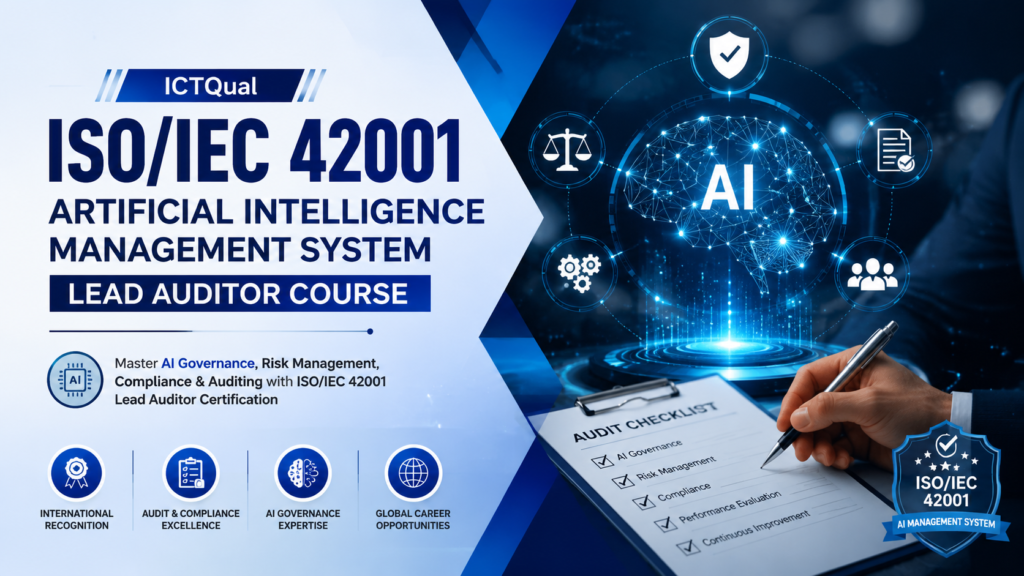
Section 1: Unit 1 : Introduction to ISO/IEC 42001:2023 Artificial Intelligence Management Systems (AIMS)
8 items
The rapid adoption of Artificial Intelligence (AI) across industries has created unprecedented opportunities while introducing new challenges related to governance, transparency, accountability, ethics, and risk management. ISO/IEC 42001:2023 is the world's first international management system standard specifically developed for Artificial Intelligence Management Systems (AIMS). It provides organizations with a structured framework to establish, implement, maintain, and continually improve the governance of AI systems throughout their lifecycle. For Lead Auditors, a thorough understanding of this standard forms the foundation for evaluating an organization's ability to manage AI responsibly, ensure regulatory compliance, and demonstrate commitment to trustworthy AI practices.nnThis chapter introduces the purpose, scope, structure, and key principles of ISO/IEC 42001:2023 while examining the role of an Artificial Intelligence Management System in supporting strategic objectives and organizational governance. Learners will explore the relationship between AI governance, risk-based thinking, ethical decision-making, stakeholder confidence, and continual improvement. The chapter also explains the Annex SL high-level structure adopted by the standard, enabling integration with other ISO management system standards and supporting a consistent auditing approach across multiple management systems.nnFrom a Lead Auditor's perspective, this introductory chapter establishes the knowledge required to assess conformity with ISO/IEC 42001:2023 using internationally recognized auditing principles. It prepares learners to understand audit terminology, identify the intent behind standard requirements, and recognize objective evidence that demonstrates effective implementation of an AIMS. Mastery of these concepts provides the essential foundation for planning, conducting, leading, and reporting first-party, second-party, and third-party audits with professionalism, impartiality, and confidence.
Lesson No : 1 Explain the purpose and structure of ISO/IEC 42001:2023.
Quiz 1 :Explain the purpose and structure of ISO/IEC 42001:2023.
Quiz
Lesson 2 : Describe the key requirements of an Artificial Intelligence Management System (AIMS).
Quiz 2 : Describe the key requirements of an Artificial Intelligence Management System (AIMS).
Quiz
Lesson 3 : Identify the principles of AI governance, ethics, and responsible AI.
Quiz 3 : Identify the principles of AI governance, ethics, and responsible AI.
Quiz
Lesson 4 : Explain the benefits of implementing an AI Management System within an organisation.
Quiz 4 : Explain the benefits of implementing an AI Management System within an organisation.
Quiz
Section 2: Unit 2 : Audit Principles, Audit Programme Management, and Audit Planning
8 items
This unit provides learners with a comprehensive understanding of the fundamental principles and practices required to plan, manage, and conduct effective audits within an Artificial Intelligence Management System (AIMS) based on ISO/IEC 42001. It introduces the internationally recognized principles of auditing, including integrity, objectivity, confidentiality, independence, evidence-based decision-making, and a risk-based approach. Learners will examine how these principles support credible and value-driven audits that evaluate the effectiveness, conformity, and continual improvement of AI governance and management systems.nnThe unit also focuses on the planning and management of audit programmes, enabling learners to develop risk-based audit schedules, define audit objectives, scope, criteria, and resources, and prepare detailed audit plans that align with organizational priorities and AI-related risks. Participants will gain practical knowledge of auditor responsibilities, audit team management, stakeholder communication, documentation requirements, and pre-audit activities. By the end of the unit, learners will be equipped to organize and plan AI management system audits systematically, ensuring they are conducted efficiently, consistently, and in accordance with the requirements of ISO/IEC 42001, ISO 19011, and internationally accepted lead auditing practices.
Lesson 1 : Explain the principles of management system auditing.
Quiz 1 : Explain the principles of management system auditing.
Quiz
Lesson 2 : Plan an ISO/IEC 42001 audit using appropriate objectives, scope, and criteria.
Quiz 2 : Plan an ISO/IEC 42001 audit using appropriate objectives, scope, and criteria.
Quiz
Lesson 3 : Develop and manage an effective audit programme.
Quiz 3 : Develop and manage an effective audit programme.
Quiz
Lesson 4 : Prepare audit plans, checklists, and supporting audit documentation.
Quiz 4 : Prepare audit plans, checklists, and supporting audit documentation.
Quiz
Section 3: Unit 3 : Conducting ISO/IEC 42001 Artificial Intelligence Management System Audits
8 items
Auditing techniques form the foundation of effective quality assurance, governance, compliance, and continuous improvement processes within modern organisations. An audit is a systematic and independent examination of activities, systems, processes, and records to determine whether they comply with established standards, policies, regulations, and organisational objectives. In today's highly regulated and competitive business environment, organisations rely on robust auditing practices to identify weaknesses, verify compliance, assess performance, and enhance operational effectiveness. Effective auditing techniques enable auditors to gather reliable evidence, evaluate controls, and provide objective conclusions that support informed decision-making and organisational improvement.nnThe auditing process involves the application of various techniques designed to collect, analyse, and verify information accurately and efficiently. These techniques may include document reviews, interviews, observations, sampling methods, data analysis, process walkthroughs, and risk-based assessments. Skilled auditors must select appropriate techniques based on the audit objectives, scope, organisational context, and level of risk involved. By applying these methods systematically, auditors can assess whether systems and processes are functioning as intended while identifying areas requiring corrective action or further investigation. The quality of audit findings largely depends on the auditoru2019s ability to utilise suitable techniques and interpret evidence critically and objectively.
Lesson 1 : Conduct Stage 1 and Stage 2 AI Management System audits.
Quiz 1 : Conduct Stage 1 and Stage 2 AI Management System audits.
Quiz
Lesson 2 : Apply appropriate audit techniques to collect objective evidence.
Quiz 2 : Apply appropriate audit techniques to collect objective evidence.
Quiz
Lesson 3 : Evaluate conformity against ISO/IEC 42001 requirements.
Quiz 3 : Evaluate conformity against ISO/IEC 42001 requirements.
Quiz
Lesson 4 : Communicate effectively with auditees throughout the audit process.
Quiz 4 : Communicate effectively with auditees throughout the audit process.
Quiz
Section 4: Unit 4 : Audit Findings, Nonconformities, Audit Conclusions, and Closing Meetings
8 items
In any ISO/IEC 42001 Artificial Intelligence Management System audit, the stage of Audit Findings, Nonconformities, Audit Conclusions, and Closing Meetings represents the most critical point where evidence is transformed into meaningful evaluation and formal outcomes. With over 15 years of experience as a Lead Auditor across management systems, I can confirm that this phase is where the true value of the audit is realizedu2014because it determines not only the level of conformity but also the maturity, reliability, and governance strength of the AI management system.nnAt this stage, auditors systematically evaluate collected evidence to identify objective audit findings, distinguishing clearly between conformity, opportunities for improvement, and nonconformities. Each nonconformity is assessed with precision, ensuring it is supported by verifiable evidence and aligned with ISO/IEC 42001 requirements. This disciplined approach ensures fairness, consistency, and technical accuracy in audit reporting, particularly important in AI systems where risks, ethics, data integrity, and model governance are tightly interconnected.nnThe development of audit conclusions then brings together all findings into a coherent judgment on the effectiveness of the management system. It is not simply about listing issues; it is about assessing whether the organizationu2019s AI governance framework is capable of achieving its intended outcomes, maintaining compliance, and supporting continual improvement.nnFinally, the closing meeting serves as the professional platform where findings are formally communicated to top management. It ensures transparency, clarifies nonconformities, confirms understanding of audit results, and sets the foundation for corrective actions. A well-conducted closing meeting reflects the integrity of the entire audit process and reinforces trust between the auditor and the organization.nnThis chapter will guide you through each of these components in a structured, practical, and auditor-focused manner, enabling you to confidently interpret findings, classify nonconformities, develop sound conclusions, and conduct effective closing meetings in real-world ISO/IEC 42001 audits.
Lesson 1 : Analyse audit evidence to determine audit findings.
Quiz 1 : Analyse audit evidence to determine audit findings.
Quiz
Lesson 2 : Classify nonconformities and identify opportunities for improvement.
Quiz 2 : Classify nonconformities and identify opportunities for improvement.
Quiz
Lesson 3 : Prepare accurate audit conclusions based on objective evidence.
Quiz 3 : Prepare accurate audit conclusions based on objective evidence.
Quiz
Lesson 4 : Conduct professional closing meetings and present audit results.
Quiz 4 : Conduct professional closing meetings and present audit results.
Quiz
Section 5: Unit 5 : Audit Reporting, Follow-up Activities, and Lead Auditor Responsibilities
8 items
In any audit process, the value of the work carried out in the field is ultimately realized through clear reporting, structured follow-up, and disciplined execution of lead auditor responsibilities. This chapter focuses on the critical final phase of the audit cycle, where findings are transformed into meaningful, actionable information for management and stakeholders.nnAudit reporting is not simply documentation; it is a formal communication tool that must accurately reflect the audit evidence, objectively present nonconformities, and highlight opportunities for improvement. A professional lead auditor ensures that reports are concise, factual, and aligned with audit objectives and applicable standards.nnFollowing the issuance of the audit report, follow-up activities play a vital role in verifying the effectiveness of corrective actions. This ensures that identified issues are not only addressed but also resolved in a sustainable manner, strengthening the overall management system.nnThroughout this chapter, emphasis is placed on the responsibilities of the lead auditor, including maintaining audit integrity, ensuring consistency in reporting, guiding audit teams, and safeguarding impartiality. A competent lead auditor not only evaluates compliance but also contributes to continual improvement by ensuring that audit outcomes lead to real organizational progress.
Lesson 1: Prepare clear, accurate, and objective audit reports.
Quiz 1 : Prepare clear, accurate, and objective audit reports.
Quiz
Lesson 2 : Verify the implementation and effectiveness of corrective actions.
Quiz 2 : Verify the implementation and effectiveness of corrective actions.
Quiz
Lesson 3 : Demonstrate the roles and responsibilities of a Lead Auditor.
Quiz 3 : Demonstrate the roles and responsibilities of a Lead Auditor.
Quiz
Lesson 4 : Apply ethical principles and professional conduct during audit activities.
Quiz 4 : Apply ethical principles and professional conduct during audit activities.
Quiz
Section 6: Unit 6 : Auditor Competence, Evaluation, and Continual Improvement of AI Management System Audits
8 items
In modern auditing practice, particularly within Artificial Intelligence Management Systems, the effectiveness of an audit is determined not only by the system being audited but fundamentally by the competence of the auditor conducting the evaluation. This chapter focuses on three interconnected pillars: auditor competence, evaluation of audit performance, and continual improvement of AI management system audits.nnAs a lead auditor trainer, I emphasize that competence goes beyond theoretical knowledge. It includes the ability to interpret complex AI-driven processes, assess algorithmic governance, evaluate risk-based controls, and apply professional judgment in dynamic and data-intensive environments. In AI audits, the auditor must also demonstrate adaptability to evolving technologies, ethical awareness, and a strong understanding of system transparency and accountability.nnThis chapter will guide you through the essential requirements for maintaining auditor competence, structured approaches for evaluating audit effectiveness, and practical methods for continual improvement. The goal is to ensure that audit professionals not only meet current standards but consistently enhance the quality, reliability, and value of AI management system audits.
Lesson 1 : Identify the competence requirements of AI Management System auditors.
Quiz 1 : Identify the competence requirements of AI Management System auditors.
Quiz
Lesson 2 : Demonstrate leadership skills required to manage audit teams.
Quiz 2 : Demonstrate leadership skills required to manage audit teams.
Quiz
Lesson 3 : Evaluate auditor performance using recognised assessment methods.
Quiz 3 : Evaluate auditor performance using recognised assessment methods.
Quiz
Lesson 4 : Promote continual improvement of audit processes and professional competence.
Quiz 4 : Promote continual improvement of audit processes and professional competence.
Quiz