ICTQual AB
ICTQual AB Welcome to ICTQual AB
Courses › ICTQual AB Level 6 Diploma in Oral and Maxillofacial Surgery (Dip OMFS)

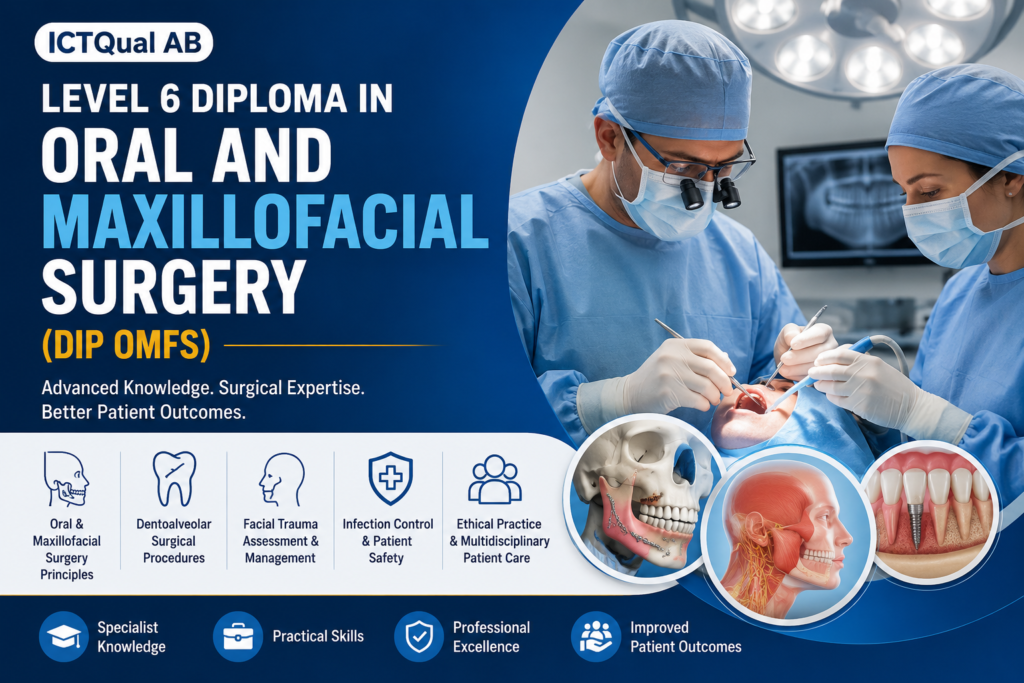
ICTQual AB Level 6 Diploma in Oral and Maxillofacial Surgery (Dip OMFS)

The ICTQual AB Level 6 Diploma in Oral and Maxillofacial Surgery (Dip OMFS) is a professional qualification designed for healthcare and dental professionals who want to develop specialist knowledge and…

Advanced 18 lessons 18 quizzes
Overview
Curriculum 36
Instructor

What You Will Learn

The ICTQual AB Level 6 Diploma in Oral and Maxillofacial Surgery (Dip OMFS) equips you with the specialist knowledge and practical skills required to support safe and effective oral and maxillofacial surgical practice. During this course, you will learn how to:

  • Understand the principles and scope of oral and maxillofacial surgery.
  • Assess and manage patients with oral, facial, and jaw conditions.
  • Apply infection prevention, patient safety, and clinical risk management practices.
  • Develop knowledge of oral pathology, facial trauma, and dentoalveolar surgical procedures.
  • Strengthen clinical decision-making, treatment planning, and ethical professional practice.
  • Communicate effectively within multidisciplinary healthcare teams to improve patient outcomes.

The ICTQual AB Level 6 Diploma in Oral and Maxillofacial Surgery (Dip OMFS) is a professional qualification designed for healthcare and dental professionals who want to develop specialist knowledge and practical skills in oral and maxillofacial surgery. This internationally recognised diploma provides comprehensive training in the assessment, diagnosis, treatment planning, and management of conditions affecting the mouth, jaws, face, head, and neck. It equips learners with the knowledge and competencies required to support safe, effective, and patient-centred clinical practice.

The programme covers essential areas of oral and maxillofacial surgery, including oral pathology, dentoalveolar surgery, facial trauma management, infection prevention and control, patient assessment, surgical planning, anaesthesia principles, pain management, medical emergencies, ethics, and professional practice. Learners also develop critical thinking, clinical decision-making, communication, and risk management skills that are essential for delivering high-quality care in modern healthcare settings.

Designed to align with international healthcare standards and current clinical practices, the ICTQual AB Level 6 Diploma in Oral and Maxillofacial Surgery (Dip OMFS) helps professionals strengthen their technical expertise while enhancing patient safety and treatment outcomes. The qualification supports continuous professional development and enables learners to build confidence in managing complex oral and maxillofacial cases through evidence-based approaches.

Whether you are looking to expand your clinical capabilities, progress within the dental and healthcare sector, or develop specialist expertise in oral and maxillofacial surgery, this diploma provides a structured pathway to professional growth. Graduates will possess the advanced knowledge, practical competencies, and ethical standards required to contribute effectively within multidisciplinary clinical teams and deliver exceptional patient care in diverse healthcare environments.

Requirements

The ICTQual AB Level 6 Diploma in Oral and Maxillofacial Surgery (Dip OMFS) is suitable for healthcare professionals seeking specialist knowledge and practical skills. Applicants should meet the following minimum requirements:

  • Age: 19 years or above.
  • Educational Background: A relevant qualification in dentistry, medicine, nursing, or another healthcare-related field.
  • Experience: Prior clinical or healthcare experience is recommended.
  • Language Proficiency: Good English reading, writing, speaking, and comprehension skills.
Section 1: Unit no 1 : Advanced Anatomy and Physiology of the Oral and Maxillofacial Region
6 items
The aim of this unit is to equip learners with an advanced, master-level comprehension of the deep surgical anatomy and complex physiological systems of the craniomaxillofacial region. It bridges advanced theoretical anatomical knowledge with high-stakes clinical application, enabling practitioners to critically analyze spatial pathways, neurovascular configurations, and hard/soft tissue healing mechanisms. Through this scientific foundation, learners will possess the clinical judgment required to safely plan, justify, and execute invasive surgical interventions while anticipating and mitigating complex intra-operative anatomical risks
Lesson no 1 Describe the detailed anatomy and physiology of the oral and maxillofacial structures.
Quiz no 1 Describe the detailed anatomy and physiology of the oral and maxillofacial structures.
Quiz
Lesson no 2 Analyse the relationship between anatomical features and surgical interventions
Quiz no 2 Analyse the relationship between anatomical features and surgical interventions
Quiz
Lesson no 3 Understand the physiological processes relevant to tissue healing and surgical outcomes.
Quiz no 3 Understand the physiological processes relevant to tissue healing and surgical outcomes.
Quiz
Section 2: Unit no 2 : Diagnosis and Treatment Planning in Oral and Maxillofacial Surgery
6 items
The aim of this unit is to enable learners to master the advanced clinical, diagnostic, and radiographic protocols required to evaluate complex maxillofacial pathologies and structural deformities. Learners will develop the capability to synthesize extensive clinical data, cross-sectional imaging, and laboratory indices into sophisticated, patient-centric treatment plans. The unit emphasizes evidence-based decision-making and multidisciplinary data evaluation to accurately identify, stratify, and mitigate potential surgical, anesthetic, and systemic post-operative risks.
Lesson no 1 Conduct comprehensive clinical and radiographic assessments for surgical cases.
Quiz no 1 Conduct comprehensive clinical and radiographic assessments for surgical cases.
Quiz
Lesson no 2 Develop effective, evidence-based treatment plans tailored to individual patient needs.
Quiz no 2 Develop effective, evidence-based treatment plans tailored to individual patient needs.
Quiz
Lesson no 3 Evaluate diagnostic data to identify potential risks and complications.
Quiz no 3 Evaluate diagnostic data to identify potential risks and complications.
Quiz
Section 3: Unit no 3 : Surgical Techniques and Procedures in Oral and Maxillofacial Surgery
6 items
The aim of this unit is to equip learners with an advanced, comprehensive understanding of the diverse surgical techniques and procedural frameworks utilized in oral and maxillofacial surgery. It focuses on developing the clinical judgment and specialized operational methodologies required to execute complex surgeries with absolute anatomical precision and strict adherence to international best practice protocols. Furthermore, the unit prepares learners to critically analyze, navigate, and manage unexpected intraoperative challenges, ensuring optimal patient outcomes and high-level safety under operating theatre conditions.
Lesson no 1 Demonstrate knowledge of a wide range of surgical techniques used in oral and maxillofacial surgery
Quiz no 1 Demonstrate knowledge of a wide range of surgical techniques used in oral and maxillofacial surgery
Quiz
Lesson no 2 Perform surgical procedures with precision and adherence to best practice protocols.
Quiz no 2 Perform surgical procedures with precision and adherence to best practice protocols.
Quiz
Lesson no 3 Manage intraoperative challenges and implement appropriate solutions.
Quiz no 3 Manage intraoperative challenges and implement appropriate solutions.
Quiz
Section 4: Unit no 4 :Management of Trauma and Complex Maxillofacial Conditions
6 items
The chapter Management of Trauma and Complex Maxillofacial Conditions provides an advanced overview of the assessment, diagnosis, treatment planning, and management strategies used for complex injuries and conditions affecting the oral and maxillofacial region. It covers the principles of managing maxillofacial trauma, including soft tissue injuries, dentoalveolar trauma, facial fractures, and complex craniofacial injuries, while focusing on clinical evaluation, diagnostic imaging, surgical decision-making, and evidence-based approaches to patient care.nnThis chapter enables learners to develop the knowledge and skills required to analyse complex maxillofacial cases, understand trauma stabilisation protocols, explore reconstructive and surgical management techniques, and evaluate postoperative care and rehabilitation strategies. It highlights the importance of multidisciplinary collaboration, functional restoration, aesthetic outcomes, and advanced clinical judgement in delivering safe and effective management of challenging oral and maxillofacial conditions.
Lesson no 1 Identify and assess traumatic injuries and complex maxillofacial conditions.
Quiz no 1 Identify and assess traumatic injuries and complex maxillofacial conditions.
Quiz
Lesson no 2 Apply multidisciplinary approaches to manage acute and chronic cases effectively.
Quiz no 2 Apply multidisciplinary approaches to manage acute and chronic cases effectively.
Quiz
Lesson no 3 Develop strategies for long-term rehabilitation and functional restoration.
Quiz no 3 Develop strategies for long-term rehabilitation and functional restoration.
Quiz
Section 5: Unit no 5 :Patient Care, Anaesthesia, and Postoperative Management
6 items
Patient Care, Anaesthesia, and Postoperative Management equips learners with the knowledge and clinical skills required to provide safe, effective, and patient-centred care throughout the surgical journey. It covers comprehensive preoperative assessment, patient preparation, risk evaluation, informed consent, and the selection of appropriate anaesthetic techniques for oral and maxillofacial procedures.nnThe chapter explores advanced airway management, local and general anaesthesia, intravenous sedation, intraoperative monitoring, fluid management, pain control, and the prevention and management of perioperative complications. Learners will develop the ability to make evidence-based clinical decisions while maintaining patient safety and adhering to professional, ethical, and regulatory standards.nnLearners will also examine postoperative recovery, rehabilitation, complication management, infection prevention, and multidisciplinary teamwork to optimise patient outcomes. By integrating current clinical guidelines, best practices, and real-world case scenarios, this chapter prepares healthcare professionals to deliver high-quality perioperative care and improve patient recovery in complex oral and maxillofacial surgical settings.
Lesson no 1 : Plan and deliver safe anaesthetic care suited to oral and maxillofacial procedures.
Quiz no 1 : Plan and deliver safe anaesthetic care suited to oral and maxillofacial procedures.
Quiz
Lesson no 2 : Manage postoperative care to promote healing and prevent complications.
Quiz no 2 : Manage postoperative care to promote healing and prevent complications.
Quiz
Lesson no 3 : Communicate effectively with patients to support their recovery and address concerns.
Quiz no 3 : Communicate effectively with patients to support their recovery and address concerns.
Quiz
Section 6: Unit no 6 : Professional Ethics, Safety, and Continuing Professional Development in Oral and Maxillofacial Surgery
6 items
Professional ethics, safety, and continuing professional development (CPD) are fundamental pillars of high-quality oral and maxillofacial surgery practice. This chapter introduces learners to the ethical principles, legal responsibilities, and professional standards that guide clinical decision-making while ensuring patient-centred care. It explores informed consent, confidentiality, professional accountability, cultural sensitivity, and ethical reasoning in complex clinical situations. Learners will also develop a clear understanding of maintaining integrity, professionalism, and patient trust in diverse healthcare environments.nnThe chapter further examines essential safety practices that support effective clinical governance and risk management within oral and maxillofacial surgery. Learners will study infection prevention and control, occupational health and safety, patient identification, safe surgical procedures, incident reporting, and strategies for reducing clinical errors. Emphasis is placed on maintaining compliance with healthcare regulations, promoting multidisciplinary teamwork, and implementing evidence-based safety measures that protect patients, colleagues, and the wider healthcare community throughout all stages of surgical care.nnIn addition, this chapter highlights the importance of lifelong learning and continuing professional development in maintaining clinical competence and advancing professional practice. Learners will explore reflective practice, clinical audit, quality improvement, research engagement, leadership development, and the application of emerging technologies and evidence-based guidelines. By strengthening ethical awareness, safety leadership, and commitment to continuous improvement, this chapter prepares future oral and maxillofacial surgery professionals to deliver safe, accountable, and high-quality patient care while adapting to the evolving demands of modern healthcare.
Lesson no 1 : Apply ethical principles and maintain professional standards in clinical practice.
Quiz no 1 : Apply ethical principles and maintain professional standards in clinical practice.
Quiz
Lesson no 2 Adhere to health, safety, and infection control regulations specific to surgical settings.
Quiz no 2 Adhere to health, safety, and infection control regulations specific to surgical settings.
Quiz
Lesson no 3 Demonstrate commitment to ongoing professional development and reflective practice.
Quiz no 3 Demonstrate commitment to ongoing professional development and reflective practice.
Quiz

Arshad Hussain

Instructor

ICTQual AB Level 6 Diploma in Oral and Maxillofacial Surgery (Dip OMFS)
£950.00
  • 18 lessons
  • 18 quizzes
  • Lifetime access