
Applying Technical & Operational Energy Management – Level 3 Worksheet
Technical and Operational Energy Management
Purpose
The purpose of this worksheet is to allow learners to apply theoretical knowledge of energy systems and operational strategies in realistic workplace situations. Learners will analyse scenarios, identify inefficiencies, recommend practical improvements, and relate them to UK legislation, standards, and operational best practices.
Objectives:
- Develop problem-solving skills for technical and operational energy management.
- Analyse energy consumption patterns and identify efficiency opportunities.
- Recommend interventions (technical, operational, and behavioural) to reduce costs and improve performance.
- Evaluate compliance requirements under UK energy regulations.
- Demonstrate practical vocational competence in energy management decision-making.
Scenario 1: Industrial Boiler System Efficiency
Background:
A mid-sized food processing plant operates two steam boilers to support production. Energy bills have increased over the last year despite no increase in production. Operators report frequent boiler cycling and inconsistent steam pressure.
Given Data:
- Boiler 1: 2,000 kW, Boiler 2: 1,500 kW
- Operating hours: 18 hours/day, 6 days/week
- Fuel: Natural gas, total annual consumption: 2,400,000 kWh
- Maintenance: Reactive, based on breakdowns only
Tasks for Learners:
- Identify operational inefficiencies and potential energy waste:
- Frequent boiler cycling
- Heat loss through poor insulation
- Overcapacity for actual production demand
- Recommend technical upgrades and operational adjustments:
- Retrofitting economisers
- Adding insulation to steam lines
- Implementing variable firing or load scheduling
- Identify behavioural interventions:
- Staff training for optimal boiler operation
- Regular monitoring of steam pressure and temperature
- Evaluate compliance with UK legislation:
- Health & Safety at Work Act (safe boiler operation)
- ESOS (energy audit identification)
- Estimate potential annual energy savings and cost reduction.
Vocational Application:
- Introduce scheduled preventive maintenance
- Install monitoring sensors and dashboards for real-time performance
- Implement load management to reduce overcapacity operation
Scenario 2: Commercial Office Lighting and HVAC
Background:
A 12-storey commercial office building experiences high electricity costs and staff complaints about temperature control. The building uses old fluorescent lighting and a central HVAC system with no occupancy controls.
Given Data:
- Lighting: 10,000 m² of office space, 1.5 W/m² fluorescent lighting
- HVAC: 3 air handling units, operating 24/7
- Electricity usage: 350,000 kWh/year
- Occupancy: 08:00–18:00, weekdays
Tasks for Learners:
- Analyse current energy use and identify inefficiencies:
- Lighting operates at full power 24/7
- HVAC heating/cooling mismatch during low occupancy
- Lack of BMS integration
- Recommend technical interventions:
- LED retrofit with motion sensors
- Zonal HVAC scheduling aligned with occupancy
- Integration with a Building Management System (BMS)
- Operational measures:Staff training to adjust thermostats appropriately
- Monitoring daily energy consumption via BMS dashboards
- Compliance considerations:
- Part L of Building Regulations (minimum energy performance)
- SECR (reporting electricity usage and efficiency measures)
- Calculate expected reduction in kWh and cost savings.
Vocational Application:
- Implement occupancy sensors and automated scheduling
- Maintain HVAC units to reduce inefficiencies
- Use dashboard monitoring for continuous improvement
Scenario 3: Residential Energy Efficiency Retrofit
Background:
A housing association plans to retrofit 50 homes to reduce energy consumption and improve EPC ratings. Homes are semi-detached, 1980s construction, with gas central heating and single-glazed windows.
Given Data:
- Average EPC: D
- Current energy bills: £1,750/year per household
- Proposed interventions: loft insulation, cavity wall insulation, LED lighting, smart thermostats
Tasks for Learners:
- Assess technical feasibility of interventions:
- Insulation thickness, window upgrades, lighting compatibility
- Prioritise interventions based on cost-effectiveness and ROI:
- Quick wins (LED lighting, smart thermostats)
- Medium-term (insulation upgrades)
- Plan monitoring and reporting strategy:
- Pre- and post-installation energy consumption
- Dashboard KPIs to track savings
- Reference applicable UK legislation:
- Building Regulations Part L
- Energy Performance of Buildings Regulations 2012
- Estimate projected energy savings and cost reductions for tenants.
Vocational Application:
- Conduct energy audits for each home
- Schedule retrofits efficiently to minimise disruption
- Document energy savings for regulatory reporting
Section 4: Practical Vocational Workflow
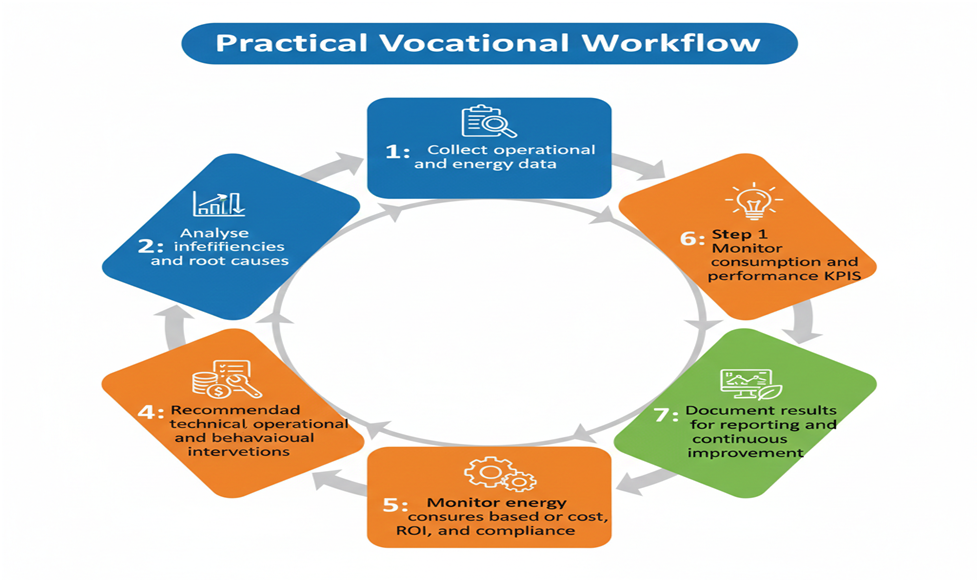
Vocational Tip:
Always link operational decisions to energy efficiency, cost reduction, and regulatory compliance. Consider the interplay of technical, operational, and behavioural factors for maximum effectiveness.
Learner Task
Instructions:
- Select one scenario from above (Industrial Boiler, Commercial Office, or Residential Retrofit).
- Prepare a brief improvement plan (approx. 500 words) including:
- Identified inefficiencies
- Recommended interventions (technical, operational, behavioural)
- Estimated energy and cost savings
- Reference to relevant UK regulations or standards
- Keep the task practical and vocational in approach.