
Practical Tips for Handling Applied Scenario Worksheets in Health & Safety Management
Health and Safety Management System (HSMS)
Introduction
This Knowledge Provision Task (KPT) is explicitly designed for the ICTQual Level 8 Professional Diploma in Health, Safety and Environmental Engineering. Transitioning to a Level 8 strategic role requires health, safety, and environmental (HSE) practitioners to move beyond rote compliance and directly apply advanced risk management theories to complex, real-world operational environments.
This Applied Scenario Worksheet serves as your primary Topic Briefing Sheet. It bridges the gap between theoretical frameworks—such as international standards, advanced hazard analysis, and United Kingdom statutory law—and the rigorous demands of frontline vocational practice. As an executive safety leader, you are expected to dissect high-risk engineering failures, interpret multi-layered hazard data, and engineer robust systemic improvements.
This document provides a comprehensive knowledge guide featuring short, workplace-based scenarios. These case studies demonstrate how to navigate the operational friction points where theory meets practice. Following this guide, you will be presented with a complex Learner Task designed to evaluate your competency in leading high-stakes incident investigations and formulating evidence-based recommendations.
A. Knowledge Guide: Applied Scenario Worksheet
This section outlines core principles of the Health and Safety Management System (HSMS) unit, applying each concept to a distinct vocational scenario. Review these applied case studies carefully, as they demonstrate the analytical depth expected of a Level 8 engineering safety professional.
Scenario 1: Hazardous Energy Control and Electrical Safety (LO6 & LO7)
The Concept:
Hazardous energy control programs (Lockout/Tagout or LOTO) are engineered to prevent the unexpected release of energy—electrical, hydraulic, thermal, kinetic, mechanical, or magnetic—during maintenance operations. This is heavily regulated in the UK under the Electricity at Work Regulations 1989 (EAWR) and the Provision and Use of Work Equipment Regulations 1998 (PUWER).
Applied Workplace Scenario:
A maintenance engineer at a UK automotive parts manufacturing plant needs to replace a damaged hydraulic ram on a 500-ton stamping press.
- The Theoretical Application: The practitioner cannot simply press the “stop” button on the operator console. Under EAWR 1989, they must establish a zero-energy state.
- The Practical Execution: The engineer applies an understanding of electrical circuits and impedance to safely isolate the primary 415V three-phase electrical supply at the main breaker, applying a physical padlock and a uniquely identified tag. However, the Level 8 practitioner also recognizes the trapped hydraulic energy. They must execute a bleed-off procedure to relieve the 3000 PSI of static hydraulic pressure in the lines and use physical blocking blocks to prevent the kinetic descent of the press ram before any work commences. Failure to implement this multi-point isolation constitutes a severe breach of UK law.
Scenario 2: Advanced Hazard Identification and Risk Matrices (LO3 & LO4)
The Concept:
Advanced risk analysis techniques, such as Failure Modes and Effects Analysis (FMEA) and Fault Tree Analysis (FTA), shift an organization from reactive hazard spotting to predictive safety engineering. These tools allow professionals to evaluate, prioritize, and implement effective risk mitigation strategies systematically.
Applied Workplace Scenario:
A civil engineering firm is deploying a new, automated tunnel-boring machine (TBM). The safety director must conduct a risk assessment compliant with the Management of Health and Safety at Work Regulations 1999 (MHSWR).
- The Theoretical Application: Instead of a basic 5×5 risk matrix, the director initiates an FMEA workshop with the engineering team.
- The Practical Execution: They analyze the TBM’s atmospheric monitoring system.
- Failure Mode: Gas sensor malfunction.
- Effect: Failure to detect explosive methane pockets.
- Risk Prioritization: The severity is catastrophic (10), occurrence is rare (2), but detectability of the failed sensor is low (8), resulting in a high Risk Priority Number (RPN).
- Mitigation: The director implements an engineering control: installing redundant, cross-calibrated sensors with an automatic, fail-safe machine shutdown sequence if discrepancies arise between the sensor readings. This demonstrates the application of the hierarchy of controls to minimize workplace risks.
Scenario 3: GHS Implementation and Chemical Safety (LO5)
The Concept:
The Globally Harmonized System of Classification and Labelling of Chemicals (GHS) ensure proper chemical hazard communication and safe handling. In the UK, this is enforced via the Control of Substances Hazardous to Health Regulations 2002 (COSHH).
Applied Workplace Scenario:
A pharmaceutical processing facility receives a new, highly concentrated industrial solvent for equipment sterilization.
- The Theoretical Application: The HSE manager must integrate this new substance into the existing HSMS.
- The Practical Execution: The manager retrieves the GHS-compliant Safety Data Sheet (SDS). They identify the corrosive and acute toxicity pictograms. Translating this to COSHH compliance, the manager designs a specific safe handling procedure. They mandate the installation of localized extraction ventilation (engineering control) and specify that operatives must wear chemical-resistant gauntlets and full-face visors (PPE). Furthermore, they design a spill response protocol, ensuring neutralizers are staged nearby, linking chemical safety directly to workplace emergency preparedness.
Scenario 4: Performance Indicators and Emerging Technologies (LO10 & LO11)
The Concept:
An effective HSMS requires interpreting leading (predictive) and lagging (historical) safety performance indicators. Integrating emerging technologies—like data analytics, robotics, and drones—can drastically improve risk monitoring.
Applied Workplace Scenario:
A structural engineering firm tasked with maintaining offshore wind turbines notes a high lagging indicator: an unacceptable rate of dropped object incidents and near-misses related to rope-access technicians working at height.
- The Theoretical Application: Relying solely on lagging indicators is insufficient. The safety director must leverage technology to improve leading indicators.
- The Practical Execution: The director implements a drone inspection program. Drones equipped with high-definition cameras and AI-driven thermal imaging conduct the initial structural integrity surveys. This entirely eliminates the human risk of working at height for the inspection phase. The leading indicator becomes “Percentage of structural inspections completed via drone vs. human access.” As this leading KPI increases, the lagging KPI of working-at-height injuries predictably decreases.
Scenario 5: Management of Change (MOC) and Incident Investigation (LO8 & LO9)
The Concept:
Management of Change (MOC) principles ensure the safe implementation of operational changes. When systems fail, practitioners must lead incident investigations using root cause analysis to manage high-risk incidents and prevent recurrence.
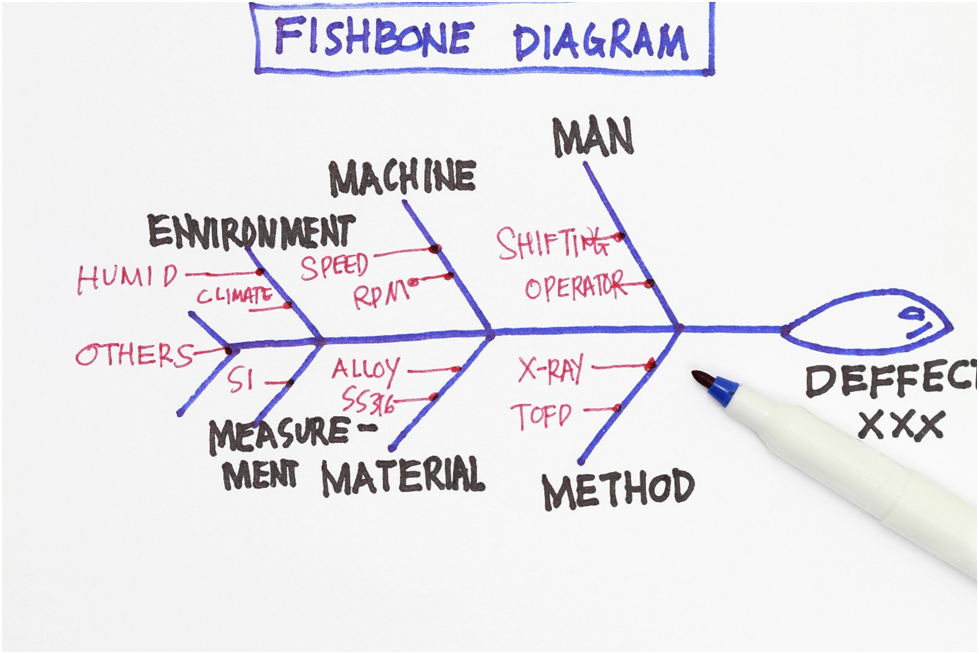
Applied Workplace Scenario:
A manufacturing plant upgrades its packaging line to a faster, automated system. Three weeks post-installation, an operative suffers a severe crushing injury to their hand.
- The Theoretical Application: The incident triggers a mandatory report under the Reporting of Injuries, Diseases and Dangerous Occurrences Regulations 2013 (RIDDOR). The safety manager must now conduct a deep-dive investigation.
- The Practical Execution: Using the Fishbone Analysis (Ishikawa) technique, the investigator looks beyond the immediate cause (the operative reaching into the machine).
- Method/Process: The MOC protocol was bypassed. The new machine was installed without an updated risk assessment.
- Equipment: The manufacturer-supplied light curtain (interlock) was misaligned during installation, creating a blind spot.
- People/Training: The operative was pressured by the shift supervisor to clear a jam quickly to maintain the new, higher production quotas.
- Root Cause: The root cause is a systemic failure in the MOC process and a breakdown in safety culture prioritizing production speed over verified safe systems of work.
B. Learner Task
Target Unit: Unit ACAI0005-1: Health and Safety Management System (HSMS)
Aligned Learning Outcome:
LO8: Lead and facilitate incident and accident investigations, including root cause analysis, identification of contributing factors, evidence collection, data analysis, and management of high-risk incidents.
Specific Evidence Required:
Complete incident investigation report including findings and recommendations.
The Assessment Scenario
You are the appointed Senior HSE Investigator for a large-scale structural steel fabrication firm operating in the UK. On Tuesday, a serious incident occurred in the main fabrication bay, which has subsequently been reported to the Health and Safety Executive (HSE) under RIDDOR 2013.
Incident Summary:
A contracted welder was conducting hot work on a structural beam. Adjacent to this workspace, a full-time employee was operating a diesel-powered counterbalance forklift truck, transporting a pallet of highly flammable industrial paint thinners. The forklift operator, attempting to avoid a newly installed but unmarked overhead extraction pipe, swerved sharply. The pallet dislodged, and a 50-liter drum of thinner ruptured, spilling its contents across the bay floor towards the welder’s workstation.
The welder’s arc ignited the vapors, causing a flash fire. The welder suffered second-degree burns to their lower extremities. The forklift operator was unharmed but deeply distressed.
Initial evidence collection reveals the following:
- The overhead extraction pipe was installed over the weekend by a third-party contractor. No formal Management of Change (MOC) documentation or updated site traffic plan was communicated to the shift workers.
- The welder’s hot work permit had expired two hours prior to the incident, yet the area supervisor allowed the work to continue.
- The forklift driver’s training certification had lapsed by three months.
- The spill kits located in the bay were depleted and had not been restocked following an audit conducted 14 days prior.
Task Instructions
You must produce a Complete incident investigation report including findings and recommendations.
Your report must demonstrate Level 8 vocational competency by systematically analyzing the scenario provided. You must strictly structure your report using the following headings:
- Immediate Causes: Identify the direct unsafe acts and unsafe conditions that triggered the flash fire.
- Root Causes (Systemic Failures): Apply analytical reasoning to identify the underlying organizational and management failures (referencing MOC, permit-to-work systems, and training matrix failures).
- UK Regulatory Breaches: Briefly identify which specific UK health and safety regulations were violated during this event (e.g., HASAWA 1974, MHSWR 1999, PUWER 1998, COSHH 2002).
- Corrective and Preventive Actions (CAPA): Provide explicit, actionable recommendations utilizing the hierarchy of controls to prevent recurrence and improve the overall organizational safety performance.
Critical Length Requirement:
The length requirement for this specific written assignment is exactly 350 words. You must synthesize your analysis and recommendations concisely and professionally to meet this strict parameter.
C. Submission Guidelines
To ensure your portfolio evidence is verified successfully and aligns with the internal quality assurance standards of the ICTQual AB, you must strictly adhere to the following submission procedures:
- Portal Upload: All assessment evidence must be uploaded directly via the official learner portal. Hard copies or email submissions will not be accepted.
- Format: Your incident investigation report must be submitted in PDF or a high-quality scanned format.
- Naming Convention: A clear naming convention must be used to ensure correct allocation. Please save your file exactly as: Unit1_YourName_IncidentInvestigationReportEvidence.
- Document Standards: Your document must be clearly labeled with the unit reference (ACAI0005-1). Ensure your learning outcomes and assessment criteria are clearly identified.
- Referencing: When referencing literature, legislation, or internal documents where no specific publication date is available, you must explicitly add fictional dates to your references (e.g., Smith, J. (2025) Safe Welding Practices or Internal Site Traffic Plan (Updated: 10 Jan 2026)) to maintain the integrity of the Harvard referencing style.
- Academic Integrity: You must submit authentic and original evidence. Act with absolute integrity; any plagiarism or misrepresentation of findings will result in a Not Yet Competent (NYC) grade.