
Electrical Project Planning: Glossary-Building Activity Tips
Electrical Project Planning, Risk, and Compliance Management
Introduction
You are required to demonstrate practical, vocational competency for the ICTQual AB Level 6 Diploma in Quality Assurance and Quality Control (QA/QC) Electrical. This specific Knowledge Providing Task is firmly rooted in the unit covering Electrical Project Planning, Risk, and Compliance Management. You must step away from theoretical definitions and prove your ability to actively manage, plan, and execute quality control measures in a high-stakes workplace environment. The documentation you produce must reflect the authoritative communication style required to direct site teams and manage complex operational scopes safely and effectively.
- Demonstrate advanced competency in strategic project planning.
- Apply practical knowledge directly to complex electrical installations.
- Establish strict quality control milestones within operational frameworks.
- Communicate technical parameters with absolute precision and authority.
Purpose of Activity
The core objective of this assessment is to completely eliminate the practice of treating technical terminology like a dictionary exercise. You must actively operationalize the language of our sector, proving that you can wield complex terms to definitively establish project scope, dictate legal liability, and enforce strict technical parameters. In a highly regulated environment, imprecise language leads to compliance failures and safety hazards; therefore, your ability to draft robust, authoritative standard operating procedures is a critical measure of your professional judgment.
- Transition your skills from theoretical academic knowledge to applied vocational leadership.
- Embed industry-standard operational language seamlessly into functional workplace policies.
- Define specific technical liabilities clearly for all involved project stakeholders.
- Prove your senior-level competency in driving quality assurance outcomes on site.
Concept Explainer Sheet
To execute this task to the required standard, you must fully internalize and deploy several critical industry concepts within your written evidence. This explainer sheet outlines the core frameworks that must be embedded logically within your standard operating procedures and project plans. You are expected to contextualize these concepts seamlessly, showing exactly how they govern the daily actions of electrical contractors, site managers, and quality inspectors during the lifecycle of an installation.
- Risk Mitigation Implementation: The active, documented process of reducing identified electrical hazards to entirely acceptable levels.
- Compliance Monitoring Integration: The continuous, systematic tracking of site activities to guarantee alignment with UK statutory requirements.
- Resource Allocation Strategy: The precise distribution of competent personnel and calibrated equipment to meet scheduled quality milestones.
- Corrective Action Protocols: The immediate, mandated procedures executed to rectify quality failures and prevent their recurrence.
Operational Terminology Required
Your technical documentation must utilize complex terminology naturally to command the actions of the workforce and define the boundaries of the project. You must avoid simply stating what a term means and instead use it in a sentence that dictates an action, limits a liability, or establishes a baseline standard. The vocabulary you choose must leave no room for misinterpretation by sub-contractors or regulatory inspectors reviewing your project plan.
- Operationalize terms like statutory duty holder and equipotential bonding within your policy instructions.
- Embed phrases such as dielectric strength verification and fault loop impedance directly into your compliance milestones.
- Use vocabulary that clearly dictates the scope of works and the boundaries of site responsibility.
- Construct authoritative directives that mandate specific isolation procedures and safe systems of work.
Required Task Evidence
For this specific competency assessment, you are required to generate one primary piece of documentary evidence: a comprehensive Project Plan with QA/QC Milestones. This document must function as a realistic, site-ready technical report that integrates a Standard Operating Procedure (SOP) for managing electrical quality control. You must draft this SOP to explicitly govern how quality interventions are triggered, who is liable for their execution, and how technical parameters are officially verified before proceeding to the next phase of installation.
- Develop a highly detailed Project Plan with distinct QA/QC Milestones.
- Author a targeted Standard Operating Procedure for regulatory compliance checks.
- Embed advanced operational vocabulary to define the exact parameters of the required inspections.
- Articulate the strict liabilities held by both the quality inspector and the installation team.
UK Regulatory Compliance
Every directive, milestone, and standard outlined in your project plan must strictly adhere to the legal and regulatory frameworks governing electrical engineering within the United Kingdom. You must interpret these national codes and weave them into the fabric of your standard operating procedures, ensuring that no planned activity violates statutory law. Your professional judgment will be evaluated on your ability to implement these specific UK regulations as non-negotiable baselines for all quality assurance activities.
- Mandate strict adherence to the Electricity at Work Regulations 1989 throughout your procedures.
- Align all technical inspection parameters directly with the BS 7671 IET Wiring Regulations.
- Integrate the overarching safety mandates of the Health and Safety at Work Act 1974.
- Apply the duties and planning requirements of the Construction Design and Management Regulations 2015.
Quality Assurance Integration
The ability to seamlessly integrate quality assurance processes into standard project scheduling is a fundamental requirement for a Level 6 professional. You must clearly document how your QA/QC milestones interact with the standard sequence of electrical installation work. The following process flow diagram illustrates the required sequential logic that you must expand upon in your detailed standard operating procedure, ensuring that quality checks act as mandatory gateways rather than optional reviews.
- Align mandatory quality inspections with critical project completion stages.
- Establish non-negotiable hold points requiring formal, documented sign-off.
- Allocate specific timeframes and competent resources for independent verification tasks.
- Maintain continuous, auditable logs of all regulatory compliance monitoring activities.
Plaintext
[Initiate Electrical Project Phase]
|
v
[Define UK Regulatory Scope]
|
v
[Establish QA/QC Hold Points]
|
v
[Execute Installation Procedures]
|
v
[Conduct Quality Control Inspection]
|
v
[Approve Milestone or Correct Action]
Technical Visualizations Required
In complex technical environments, written instructions must often be supported by clear visual representations to ensure full comprehension by the site team. You must incorporate professional visual aids within your project plan to map out the quality control timeline and structural hierarchy. These visual elements must directly support your written standard operating procedures and clearly highlight the critical integration of UK regulatory hold points.
- Provide detailed visual representations of your proposed project timeline and hold points.
- Include clear structural charts outlining the QA/QC reporting and liability hierarchy.
- Ensure all visual data is labelled with precise, operational industry terminology.
- Integrate placeholders for operational images demonstrating compliant physical installations.
Learner Task
To demonstrate your competency in this unit, you are required to produce highly detailed, professional-grade documentation that reflects the realities of a complex electrical project. This task will test your ability to synthesize planning, risk, and compliance into a cohesive, actionable format using precise operational terminology. You must approach this assignment with the rigor and precision expected of a senior QA/QC professional, ensuring that every detail aligns strictly with the standards set forth by the ICTQual AB Level 6 Diploma in Quality Assurance and Quality Control (QA/QC) Electrical.
EVIDENCE GENERATION REQUIREMENT:
- Gantt Chart / Resource Schedule
Contextual Scenario:
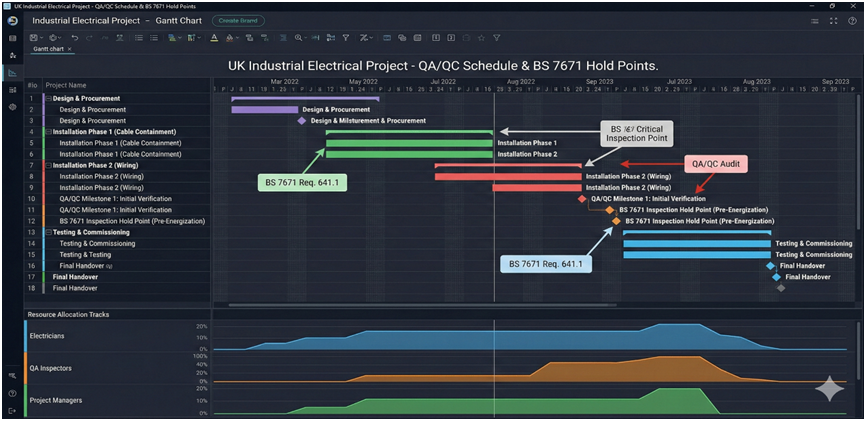
You are the lead QA/QC planner for a major industrial electrical upgrade in the UK. The project involves multiple phases, including primary cable containment, high-voltage wiring, and final testing and commissioning. You must develop a scheduling document that definitively dictates operational timeframes, resource distribution, and statutory hold points for your site teams.
Task Execution:
Develop a comprehensive Gantt Chart / Resource Schedule that actively operationalizes quality assurance within the project timeline.
- Step 1: Map out the primary installation phases of the industrial electrical project, establishing specific timeframes for cable containment, wiring, and commissioning.
- Step 2: Embed mandatory QA/QC hold points directly into the schedule, ensuring these are positioned as non-negotiable gateways before subsequent phases can begin. Use operational terminology like dielectric strength verification and fault loop impedance to define the technical parameters of these milestones.
- Step 3: Allocate competent resources, specifying the exact distribution of qualified electricians, site managers, and independent QA inspectors required for each operational phase and hold point.
- Step 4: Integrate strict regulatory compliance markers within the timeline. You must explicitly reference the BS 7671 IET Wiring Regulations for technical hold points and incorporate the scheduling duties required by the Construction Design and Management Regulations 2015.
- Step 5: Draft a one-page operational directive to accompany the schedule. This directive must dictate the exact liabilities of the installation team versus the quality inspector during the designated hold points, mandating strict adherence to the Electricity at Work Regulations 1989.
Submission Guidelines:
Your final submission must be a polished, professional scheduling document ready for review by site directors and regulatory bodies.
- Ensure your operational language is contextually accurate, precise, and highly authoritative, leaving no room for misinterpretation.
- The document structure must clearly demonstrate the sequential logic and mandatory nature of the quality inspections.
- Verify meticulously that all regulatory references apply exclusively to the United Kingdom.
- Submit the completed Gantt Chart / Resource Schedule and accompanying operational directive as a standard PDF document.