
“Applied Learning in Concrete Structures: Glossary-Building Activity for NDT Training
Introduction to Concrete Technology
Introduction to the Task
Welcome to this critical phase of your ICTQual AB Certificate in NDT of Concrete Structures – Engineering. As professionals operating in the built environment, the language we use is the foundation of our diagnostic accuracy. Throughout my two decades of inspecting civil infrastructure across the United Kingdom, I have seen firsthand how imprecise terminology leads to misdiagnoses, inappropriate Non-Destructive Testing (NDT) deployments, and ultimately, catastrophic structural failures. We do not use terminology simply to sound educated; we use it to establish a precise, legally defensible baseline of a structure’s condition.
This Knowledge Provision Task (KPT) is designed to transition your vocabulary from academic memorization to operational fluency. When you stand beneath a deteriorating bridge deck or inspect a high-rise shear wall, you must be able to immediately translate visual anomalies into standardized, professional terminology. This shared lexicon is what allows NDT technicians, structural engineers, and asset managers to communicate effectively. In this task, you will focus heavily on operationalizing your vocabulary. You are stepping beyond knowing what a word means in a textbook; you are demonstrating that you can correctly label visual pathology in the field and understand how that specific defect dictates your subsequent NDT approach.
Purpose
The primary objective of this Knowledge Provision Task is to build a highly operationalized glossary of concrete pathology. It aims to evaluate your competency in visually identifying concrete surface defects and linking those observations directly to standardized terminology and subsequent diagnostic strategies. You will prove your ability to recognize the basic, yet critical, vocabulary of our trade by capturing and categorizing photographic evidence of visible defects. This ensures that when you report an anomaly, your assessment is aligned with UK industry standards and conveys precise, actionable data to the wider engineering team.
1. The Operational Lexicon of Concrete Composition
- Cementitious Paste Integrity: In the field, we do not simply look at cement; we evaluate the integrity of the paste matrix. When assessing a structure, recognizing a compromised matrix tells an NDT technician whether to expect uniform ultrasonic pulse velocities or high signal attenuation. A degraded paste implies increased porosity, which directly informs our approach to cover meter surveys.
- Aggregate Interlock and Distribution: Your vocabulary must encompass the visual and structural role of aggregates. Segregation is not just a definition; it is a physical reality where heavy aggregates settle, leaving a weak, cement-rich layer at the surface. When you identify segregation visually, you immediately know that rebound hammer readings taken in that specific area will be unrepresentative of the core structural strength.
- Moisture Migration Paths: Understanding the role of water in the mix translates to identifying bleed channels on the surface. These channels are not merely aesthetic flaws; they are capillary highways for chloride ingress, particularly relevant for structures exposed to UK coastal environments or de-icing salts on our highway networks.
- Admixture Influence Traces: While we cannot see chemical admixtures, we can observe their operational footprint. For instance, the over-dosage of a retarder might present as a persistently soft surface long after the initial cure, completely altering the parameters you would set for a semi-destructive pull-off test.
2. Diagnosing the Behavior of Concrete Over Time
Concrete is an active, dynamic material that responds aggressively to its environment. Your ability to name the behavior is inextricably linked to your ability to test for it.
When we discuss the behavior of concrete, we must first address the environmental loads typical of the United Kingdom. We operate in a climate defined by persistent moisture, cyclic freezing, and extensive coastal exposure. The vocabulary of concrete behavior here is a vocabulary of survival and degradation. Let us consider the phenomenon of carbonation. To a novice, carbonation is a chemical reaction involving carbon dioxide. To a Level 6 candidate, carbonation is an advancing front of reduced alkalinity that destroys the passive layer protecting steel reinforcement. When you describe carbonation in a field report, you are signaling the immediate need for phenolphthalein testing and subsequent half-cell potential mapping to gauge the extent of hidden corrosion.
Similarly, the language we use around thermal behavior must be exact. Early-age thermal contraction does not look the same as long-term drying shrinkage, and confusing the two in your defect log demonstrates a lack of competency. Thermal contraction typically presents as full-depth cracks occurring shortly after the pour, often in thick sections where the core temperature vastly exceeded the surface temperature. Drying shrinkage, conversely, presents as finer, shallower crazing on the surface. Identifying the correct behavior dictates the remediation strategy: one requires structural intervention, while the other might only necessitate a surface sealant to prevent moisture ingress. Your vocabulary drives the engineering response.
3. The Intersection of Vocabulary and Non-Destructive Testing
- Defect Triage: The terminology you assign to a visual defect acts as a triage mechanism. If you label a surface anomaly as “honeycombing,” you are stating that the concrete was poorly consolidated and that significant voids exist. This immediately triggers the requirement for Ground Penetrating Radar or Ultrasonic Echo testing to determine the depth and severity of the voiding.
- Method Selection: Precise language governs NDT method selection. Labeling a defect “delamination” implies a subsurface separation parallel to the surface. An experienced technician knows that a cover meter is useless for finding delamination, but impact-echo or infrared thermography will map it perfectly.
- Data Interpretation: The words you use frame the data you collect. If you record “scaling” on a bridge pier subjected to tidal zones, you anticipate that your ultrasonic pulse velocity readings will be erratic near the surface due to frost or salt crystallization damage. The visual diagnosis provides the necessary context to interpret the NDT data correctly.
- Reporting Protocols: In accordance with UK best practice, your reporting terminology must be unequivocal. When presenting findings to a structural engineer, stating that a wall “looks bad” is unacceptable. Stating that the wall exhibits “severe spalling with exposed, corroding reinforcement indicative of chloride attack” is a professional, actionable diagnosis based on a highly operationalized vocabulary.
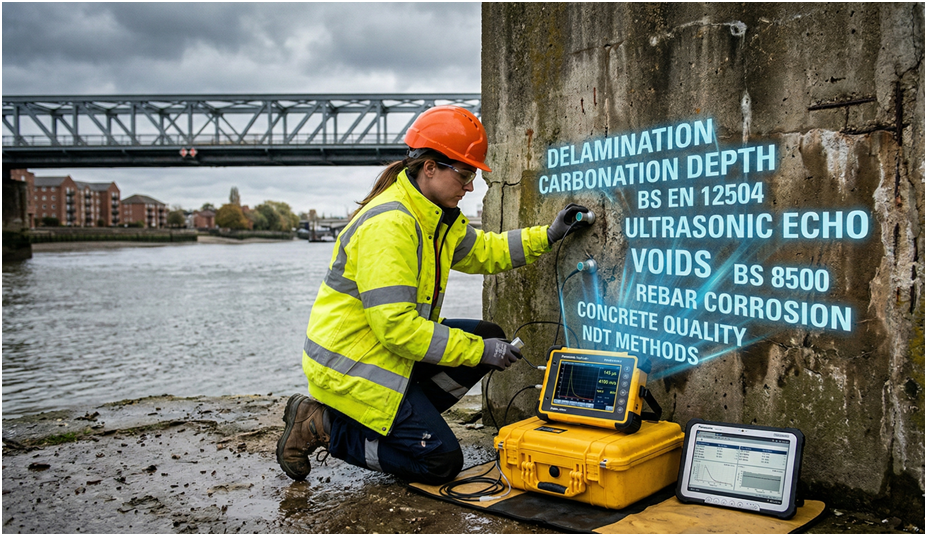
4. Visual Manifestations and Standardized Categorization
| Standard Terminology | Field Manifestation | Competency-Based NDT Implication |
| Plastic Settlement Cracking | Cracks mirroring the layout of the top layer of reinforcement. Often occurs while the concrete is still highly workable. | Indicates potential early-stage bond loss between steel and concrete. Requires careful cover meter surveys to map the rebar beneath the specific crack lines. |
| Alkali-Silica Reaction (ASR) | Classic map-cracking or “isle of man” cracking patterns on the surface, often accompanied by a yellowish gel exudate. | High internal expansion is occurring. Requires long-term structural monitoring, potentially using embedded fiber optic sensors or regular ultrasonic thickness gauging to track degradation over time. |
| Honeycombing | Stony, voided areas lacking cement paste, typically located at joints or formwork boundaries. | Represents a severe local reduction in compressive strength and durability. Demands immediate volumetric assessment using ultrasonic pulse echo to determine the depth of the unconsolidated zone. |
| Spalling | Fragments of concrete detaching from the main body, often exposing rusted reinforcement beneath. | A late-stage symptom of internal expansion, usually from corroding steel. Mandates a full corrosion suite investigation, including half-cell potential and electrical resistivity testing across the wider structural element. |
5. Integrating UK Standards into Defect Lexicon
Operating within the United Kingdom necessitates a strict adherence to recognized national standards. Our vocabulary is not arbitrary; it is codified. When you identify and name a defect, you are functioning within the framework of BS EN 1504 (Products and systems for the protection and repair of concrete structures) and the overarching Health and Safety Executive (HSE) guidelines regarding structural integrity.
A competent NDT professional does not invent terms. You do not call a defect a “hole” when the BS EN standard defines it as a “void” or “honeycombing.” This standardization is crucial for legal liability and asset management. If a structure fails and your reports are subpoenaed, your use of standardized, recognized terminology proves that your inspection was conducted professionally and systematically. Furthermore, aligning your vocabulary with UK standards ensures that any subsequent repair contracts put out to tender are based on an accurate, universally understood description of the pathology. Your words form the basis of multi-million-pound remediation strategies.
You must view your glossary not as a list of words, but as your professional toolkit. Every time you correctly match a visual cue to its standardized term, you are demonstrating your competence to practice in the field. You are proving that you can look at the chaotic surface of a deteriorating retaining wall and impose engineering order upon it through precise identification.
LEARNER TASK: Glossary-Building Activity (Visual Defect Mapping)
Evidence Requirement Selected:
- Photographic evidence identifying visible defects (cracking, scaling, honeycombing).
Task Brief:
- You are required to demonstrate your operational vocabulary by completing a Photographic Glossary matching activity. Unlike a traditional academic test where you write definitions, you will act as the field inspector. You must curate a portfolio of photographic evidence from real-world concrete structures (or robust simulated environments) and definitively link these visual symbols to their correct professional terminology and NDT implications.
Instructions:
- Step 1: Conduct a visual survey of a concrete structure (this can be a local retaining wall, a public car park, or a bridge abutment) and capture high-resolution photographic evidence of at least three distinct types of surface defects. You must specifically seek out and photograph: a) A specific classification of cracking (e.g., plastic shrinkage, structural shear, or flexural cracking). b) An area exhibiting scaling or surface degradation. c) An area exhibiting honeycombing or voiding.
- Step 2: Create a professional “Visual Glossary Log.” For each photograph you provide, you must accurately match the visual evidence to its specific, standardized industry term. Do not use generic terms like “broken concrete.”
- Step 3: Beside each matched photograph and term, write a brief, competency-based justification (maximum one paragraph per defect). In this justification, you must explain why the visual evidence matches the term, what underlying concrete behavior caused it, and crucially, name one Non-Destructive Testing (NDT) method you would deploy next to investigate this specific defect further.
- Step 4: Ensure all photographs are clearly annotated (using arrows or circles) to draw the reviewer’s eye to the exact pathology you are naming.
Remember: The core objective is operationalization. Show me that you can look at a wall, take a picture, name the defect correctly according to UK professional norms, and know exactly what to do next.
Submission Guidelines
- Document Format: Submit your final work as a single, securely formatted PDF document to preserve image layout and text alignment.
- Image Quality: Ensure all photographic evidence is of high resolution, well-lit, and in focus. Blurry images where the defect cannot be clearly distinguished will be rejected, just as they would be by a client.
- Annotation Competency: Digital annotations on the photographs must be professional, clearly highlighting the boundary of the defect being categorized.
- Professional Language: Utilize strict, professional engineering terminology throughout your justifications. Avoid colloquialisms or subjective descriptions.
- Referencing: Where appropriate, ensure your terminology aligns with relevant UK standards (e.g., BS EN terminology for concrete defects). Do not reference international codes outside the UK framework.
- Originality: All photographic evidence must be original and captured by you, or clearly cited if drawn from a permitted professional archival database for the purpose of this assessment. Stock images from search engines are not acceptable and demonstrate a lack of field competency.
- Submission Naming Convention: Save your file as [Your Surname]_[Your First Initial]_Unit1_VisualGlossary.pdf prior to uploading it to the assessment portal.