
Myth vs Fact in Energy Management: Level 3 Guide
Introduction to energy management
Purpose
The purpose of this activity is to develop critical thinking and professional judgment in junior energy or operations personnel. Rather than memorising “true/false” statements, learners will:
- Identify common misconceptions or bad practices (Myths) in energy management and safety
- Analysewhy these myths occur and the risks they create
- Correct them using evidence-based practices (Facts)
- Understand the behavioural and organisational impact of shortcuts or unsafe assumptions
This exercise strengthens safety culture, compliance, and operational reliability in line with UK workplace standards.
Section 1: Common Energy Management Myths in the Workplace
| Myth (Incorrect Belief / Shortcut) | Why It Occurs | Potential Risk / Consequence |
| Leaving lights and computers on saves time | Convenience; avoids rebooting or interruptions | Increased energy costs; higher carbon footprint |
| Compressed air leaks are “small losses” | Invisible or low-sound leaks; ignored in audits | Wasted electricity, potential equipment damage |
| Boilers and HVAC only need service when broken | Misunderstanding preventative maintenance | Reduced efficiency; risk of failure; higher costs |
| Energy monitoring is “administrative only” | Seen as paperwork or non-operational | Missed inefficiency detection; non-compliance with SECR |
| Turning off thermostats completely saves more energy | Lack of understanding of HVAC systems | Equipment strain; temperature fluctuations; higher energy use |
| Renewable energy is “too expensive for small sites” | Cost perception; lack of lifecycle analysis | Missed long-term savings and carbon reduction opportunities |
| Net-zero is only for large companies | Misconception; thought irrelevant for SMEs | Poor planning; regulatory non-compliance risk |
Section 2: Correcting Myths with Facts (Safety & Compliance)
| Myth | Correct Fact / Safety Rule | Workplace Application / Example |
| Leaving lights and computers on saves time | Turn off non-essential equipment when not in use; follow shutdown checklist | Office floor: automatic reminder to switch off lights and PCs after working hours |
| Compressed air leaks are “small losses” | All leaks should be identified and repaired promptly | Maintenance logs show 25% reduction in air loss after repair |
| Boilers and HVAC only need service when broken | Preventative maintenance ensures efficiency and safety | Schedule quarterly inspections and cleaning of boiler systems |
| Energy monitoring is “administrative only” | Use data to detect trends, inefficiencies, and inform decisions | Sub-metering data triggers alert for unusual energy spikes |
| Turning off thermostats completely saves more energy | Maintain optimal temperature set points; gradual reduction is safer | Office HVAC set between 19–21°C, no abrupt shutdowns |
| Renewable energy is “too expensive for small sites” | Lifecycle cost analysis often shows payback within 3–5 years | Small retail store installs solar PV, reducing electricity bill by 15% |
| Net-zero is only for large companies | All organisations benefit from planning carbon reduction | Implement energy-saving measures and carbon offsetting regardless of size |
Section 3: Root Cause Analysis of Energy Myths
Learners should understand why myths persist:
- Lack of awareness: Junior staff may not know the real energy cost of running equipment unnecessarily.
- Convenience vs compliance: Shortcuts save immediate effort but create long-term inefficiency.
- Perception of risk: Some operators underestimate the operational and financial risk of inefficient practices.
- Insufficient monitoring: If energy use isn’t measured or reported, bad habits continue unnoticed.
- Cost misunderstanding: Misconceptions about investment payback can prevent energy-saving actions.
Section 4: Visual Example – Myth vs Fact Workflow
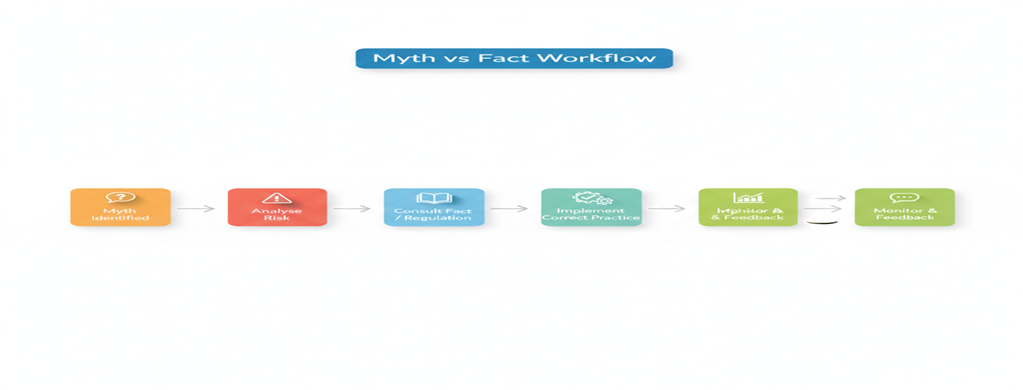
Example: Compressed Air Leak
- Myth: “Small leaks are harmless.”
- Risk: 25% energy loss → higher electricity cost
- Fact: All leaks increase energy consumption and must be repaired
- Action: Repair leaks; install sub-metering
- Monitor: Monthly energy dashboard shows reduced consumption
Section 5: UK Regulatory References Relevant to Myths
| Practice | UK Regulation / Guidance | Implication |
| Energy monitoring and reporting | Streamlined Energy and Carbon Reporting Regulations 2018 | Ensures all medium/large companies track energy use and carbon |
| Preventative maintenance | Health & Safety at Work Act 1974 | Equipment maintenance ensures safety, reduces energy waste |
| Compressed air efficiency | ESOS Regulations 2014 | Energy audits must identify inefficiencies in significant energy systems |
| Lighting / HVAC control | Building Regulations 2010 (Part L) | Legal minimum standards for energy efficiency in commercial buildings |
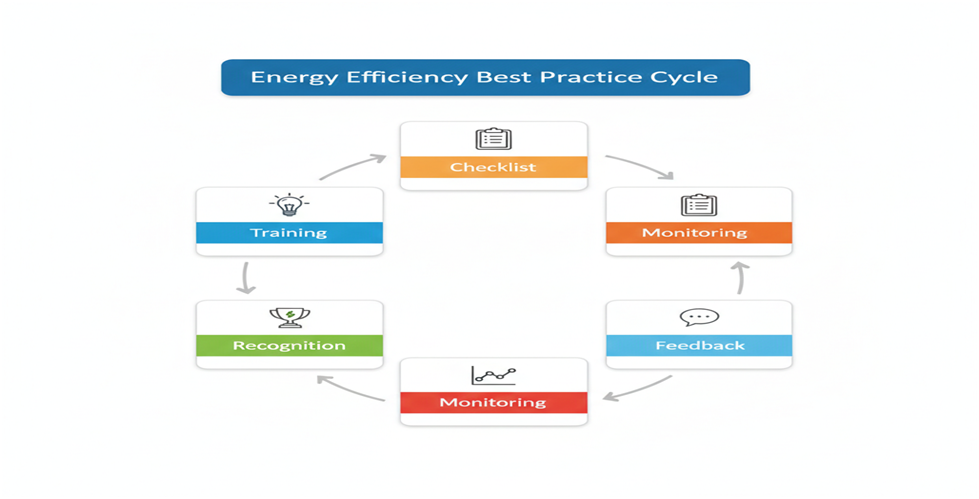
Section 6: Behavioural Change Principles
To correct myths, junior operators must:
- Be trained in correct practices using real examples
- Receive visual reminders (posters, dashboards)
- Have clear SOPs and checklists for daily energy tasks
- Understand the financial and safety impact of shortcuts
- Participate in feedback loops with energy managers
Visual Example:
Learner Task
Select three common energy or safety myths from the table above. For each:
- Explain why the myth occurs in the workplace.
- Identify the specific fact or safety rule that corrects it.
- Describe how you would implement the fact in practice (e.g., training, SOP, monitoring).
- Include one relevant UK regulation that supports this practice.