
Introduction to Medical Laboratory Science Concepts Explained
Introduction to Medical Laboratory Science
Purpose
Medical laboratory science involves complex systems, regulations, and scientific principles.
This sheet breaks down difficult concepts into:
- Clear explanations
- Step-by-step logic
- Workplace examples
- Simple visual diagrams
- Practical competency links
The goal is to make learners confident in applying theory within UK clinical laboratory environments.
CONCEPT 1: How Laboratory Science Supports Diagnosis
The Difficult Idea
“Laboratory medicine provides objective biochemical, haematological, and microbiological data to support clinical decision-making.”
Simplified Explanation
Doctors often cannot see what is happening inside the body.
Laboratory tests provide measurable evidence.
Think of the laboratory as:
The “evidence department” of healthcare.
Simple Visual
Patient Symptoms
↓
Doctor Orders Test
↓
Laboratory Analyses Sample
↓
Result Sent to Clinician
↓
Treatment Decision
Workplace Example
A patient presents with fatigue.
- Blood sample sent to haematology.
- Haemoglobin measured.
- Result shows low level.
- Diagnosis: Iron deficiency anaemia.
- Treatment prescribed.
Without laboratory analysis, diagnosis would be guesswork.
CONCEPT 2: Structure of a Modern Medical Laboratory
The Difficult Idea
Laboratories operate under structured governance systems ensuring traceability, quality control, and accreditation compliance.
Simplified Explanation
A laboratory is not just benches and machines.
It is an organised system with:
- Departments
- SOPs
- Quality checks
- Documentation control
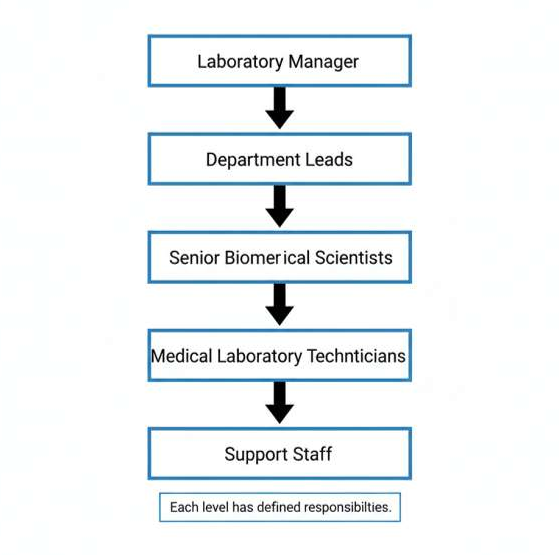
- Supervision hierarchy
Simple Structural Diagram
Workplace Example
If equipment fails:
Technician → informs Senior → logged → Quality Manager reviews → corrective action implemented.
This structure prevents unsafe practice.
CONCEPT 3: Biosafety and Risk Control
The Difficult Idea
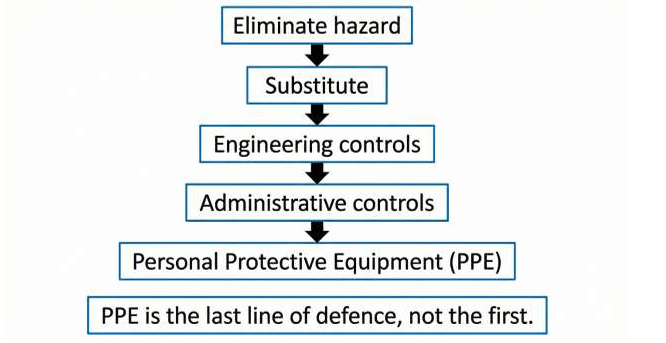
Risk assessment identifies hazards, evaluates exposure likelihood, and implements hierarchical control measures.
Simplified Explanation
Before doing a task, ask:
- What could harm me?
- How likely is it?
- What can prevent it?
Hierarchy of Control (Visual)
Workplace Example
Handling a blood sample:
Hazard: Bloodborne infection
Control measures:
- Gloves
- Lab coat
- Sharps container
- Vaccination policy
- Spill kit available
UK laws involved:
- COSHH Regulations 2002
- Health and Safety at Work etc. Act 1974
CONCEPT 4: Difference Between Major Laboratory Disciplines
Haematology
Focus: Blood cells and clotting
Example Tests:
- Full Blood Count
- Coagulation profile
Risk: Bloodborne pathogens
Biochemistry
Focus: Chemical analysis of body fluids
Example Tests:
- Glucose
- Liver enzymes
- Kidney function
Risk: Chemical exposure and sample stability issues
Microbiology
Focus: Identification of infectious organisms
Example:
- Bacterial cultures
- Antibiotic sensitivity testing
Risk: Airborne and contact transmission
Comparison Visual
| Discipline | Main Focus | Primary Risk | Equipment Type |
|---|---|---|---|
| Haematology | Cells | Blood infection | Cell counters |
| Biochemistry | Chemicals | Chemical hazard | Analysers |
| Microbiology | Microorganisms | Infection spread | Incubators |
CONCEPT 5: Quality Control vs Quality Assurance
The Difficult Idea
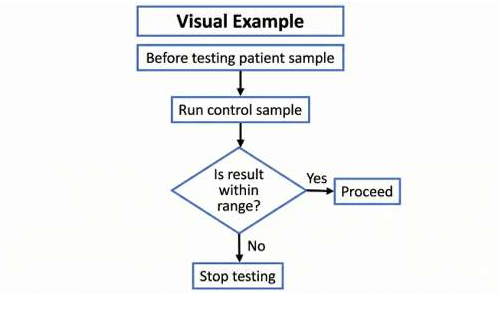
Quality control (QC) monitors individual tests; quality assurance (QA) ensures the entire system functions correctly.
Simplified Explanation
Quality Control = Checking today’s result
Quality Assurance = Making sure the whole system is reliable
Visual Example
Workplace Importance
Releasing inaccurate results may:
- Mislead clinicians
- Harm patients
- Breach ISO 15189 standards
CONCEPT 6: Confidentiality and Data Protection
The Difficult Idea
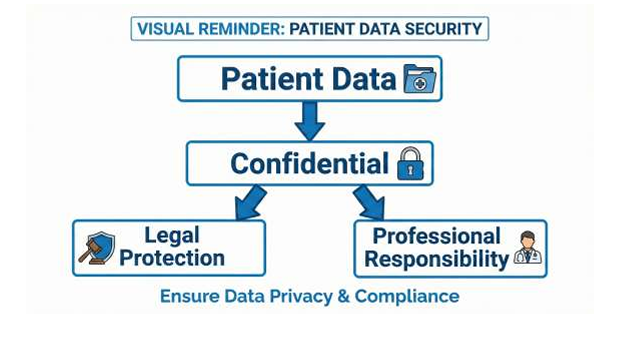
Patient data is protected under UK GDPR and must not be processed unlawfully.
Simplified Explanation
Patient information belongs to the patient.
Technicians must:
- Access only necessary information.
- Never discuss results publicly.
- Secure computer systems.
Visual Reminder
Workplace Example
Leaving a computer logged in while unattended may result in data breach.
Consequences:
- Disciplinary action
- Regulatory investigation
- Legal penalties
CONCEPT 7: Professional Accountability
The Difficult Idea
Laboratory professionals are personally accountable for actions affecting patient care.
Simplified Explanation
Even if instructed by someone senior, you are responsible for your actions.b
Example
If told to ignore abnormal QC results and continue testing:
Correct action: Refuse and escalate.
UK protection:
- Public Interest Disclosure Act 1998
CONCEPT 8: Why Standard Operating Procedures (SOPs) Matter
The Difficult Idea
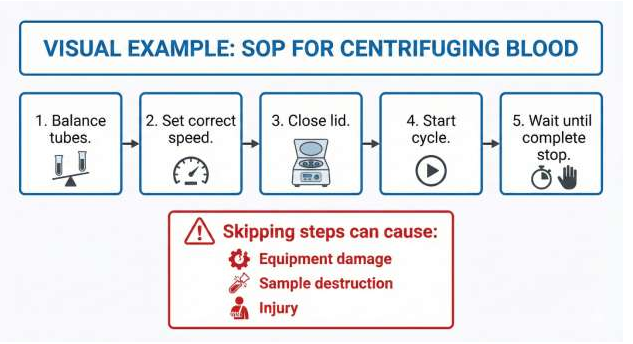
SOPs ensure reproducibility, safety, and compliance.
Simplified Explanation
SOPs are step-by-step instructions that must be followed exactly.
Visual Example
INTEGRATED WORKPLACE CONNECTION
In a single working day, a technician may:
- Register samples (confidentiality law applies)
- Handle blood (biosafety law applies)
- Run analyser (quality control standards apply)
- Communicate results (professional conduct applies)
All concepts are interconnected.
Learner Task
Required Evidence:
Technical report or explainer on the use of laboratory instruments and basic automation; and a maintenance and calibration log template for a specific laboratory instrument.
Objective:
Demonstrate technical understanding of how laboratory instruments and automated systems are used to support diagnostic accuracy. You must show how the “Standard Operating Procedures (SOPs)” and “Maintenance Cycles” discussed in this sheet are applied to specific pieces of equipment in a UK-regulated laboratory environment.
Instructions:
Instrumentation Explainer Report:
- Select two major pieces of laboratory equipment from different disciplines (e.g., a Haematology Analyser and a Microbiology Incubator/Automated System).
- For each instrument, explain its primary function and the underlying scientific principle it uses to generate results (e.g., impedance/flow cytometry for blood cells).
- Discuss the advantages of automation over manual methods in terms of throughput, precision, and the reduction of human error.
Maintenance and Calibration Logic:
- Create a “Maintenance and Calibration Log Template” for one of your chosen instruments.
- Detail the required frequency for Daily, Weekly, and Monthly maintenance tasks (e.g., cleaning probes, checking reagents, or thermal validation).
- Explain the role of Calibration in ensuring the instrument remains compliant with ISO 15189 standards and produces results that are traceable to international benchmarks.
Troubleshooting and SOP Application:
- Describe the step-by-step procedure to follow if an automated instrument produces an “Error Code” or an out-of-range “Quality Control” result.
- Identify the specific SOP (Standard Operating Procedure) that would guide your troubleshooting and explain why continuing to test on a faulty instrument is a breach of the Health and Safety at Work Act 1974.
Professional Technical Rationale:
- Provide a 500-word justification explaining how a Medical Laboratory Technician ensures that “Automation” does not replace “Professional Judgment.”
- Discuss the importance of a technician’s role in verifying results before they are released into the LIMS (Laboratory Information Management System).