
Expert Tips for Glossary-Building Activities in HSMS Unit of Level 8 Diploma
Health and Safety Management System (HSMS)
Introduction
This Knowledge Provision Task (KPT) is designed for candidates completing the ICTQual Level 8 Professional Diploma in Health, Safety and Environmental Engineering. At a Level 8 standard, the expectation of your competence shifts drastically. You are no longer merely expected to memorize and recite safety terminology; you are required to wield it as a strategic, operational, and legal tool.
In high-risk engineering environments governed by strict United Kingdom (UK) legislation, vague language in a safety policy can lead to catastrophic operational failures and severe corporate liability. This KPT focuses on a comprehensive Glossary-Building Activity. However, the core objective is to stop treating terminology like a dictionary exercise. The goal is to operationalize the language. You must demonstrate how to embed complex terms into technical reports, Standard Operating Procedures (SOPs), and workplace policies to clearly define scope, limit liability, and establish strict technical parameters.
This comprehensive guide will demonstrate how to transition academic definitions into actionable, legally sound UK safety directives. Following this guide, you will be tasked with authoring a highly precise procedural document utilizing this operationalized approach.
A. Knowledge Guide: Glossary-Building & Operationalizing Language
To design an effective Health and Safety Management System (HSMS), a practitioner must communicate with absolute precision and authority. In a regulated environment, words act as protective barriers. If an engineering procedure requires a machine to be “turned off,” that is vague and dangerous. If the procedure requires the machine to be brought to a “Zero Energy State via Positive Isolation,” you have established a rigorous, legally defensible technical parameter.
Below is an in-depth guide demonstrating how to operationalize key terminology across various learning outcomes of the HSMS unit, aligning them directly with UK statutory requirements such as the Health and Safety at Work etc. Act 1974 (HASAWA), the Management of Health and Safety at Work Regulations 1999 (MHSWR), and the Provision and Use of Work Equipment Regulations 1998 (PUWER).
Terminology Set 1: Hazardous Energy Control (LO6)
The design and implementation of hazardous energy control programs covering electrical, hydraulic, thermal, kinetic, mechanical, and magnetic energy sources is a critical competency.
1. Zero Energy State
- Academic Definition: The condition in which a piece of equipment or machinery has no stored or active energy remaining.
- UK Legal Context: Under PUWER 1998, employers must ensure that work equipment is provided with readily accessible means to isolate it from all its sources of energy.
- Operationalized Application (In an SOP): “Prior to the commencement of any intrusive maintenance on the hydraulic press, the Authorized Technician must verify that the equipment has reached a verified Zero Energy State. This requires not only the disconnection of the primary 415V electrical feed but also the complete dissipation of all residual pneumatic pressure in the accumulator lines to 0 PSI, confirmed via physical gauge inspection.”
2. Positive Isolation
- Academic Definition: The act of physically separating a system from its energy source to prevent accidental re-energization.
- UK Legal Context: Aligns with the Electricity at Work Regulations 1989 (EAWR), which mandates precautions to prevent electrical equipment from becoming electrically charged during work.
- Operationalized Application (In a Policy): “The facility operates a strict Positive Isolation protocol. Relying on software interlocks or emergency stop (E-stop) circuitry is explicitly prohibited for maintenance activities. Positive isolation must be achieved through the application of a physical, keyed padlock and customized danger tag at the primary energy isolation point, ensuring the equipment remains inoperable until the specific technician removes their lock.”
Terminology Set 2: Hazard Control and Risk Assessment (LO2 & LO4)
Applying the hierarchy of hazard control measures and utilizing risk assessment methodologies are foundational to UK compliance.
3. Hierarchy of Hazard Control
- Academic Definition: A system used in industry to minimize or eliminate exposure to hazards, ranked from most effective to least effective.
- UK Legal Context: MHSWR 1999 legally requires employers to apply the principles of prevention in a specific order, making the hierarchy a statutory obligation, not just a guideline.
- Operationalized Application (In a Technical Report): “In mitigating the risks associated with the new solvent-based coating process, the engineering team applied the Hierarchy of Hazard Control. Elimination was unfeasible due to product specifications. Therefore, engineering controls have been mandated as the primary defense: a Local Exhaust Ventilation (LEV) system has been installed to capture volatile organic compounds (VOCs) at the source, actively preventing atmospheric saturation and reducing our reliance on operative Personal Protective Equipment (PPE).”
4. As Low As Reasonably Practicable (ALARP)
- Academic Definition: A principle indicating that a risk has been reduced to a level where the cost of further reduction is grossly disproportionate to the benefit gained.
- UK Legal Context: This is the core qualifying phrase in the Health and Safety at Work etc. Act 1974. Employers must ensure safety “so far as is reasonably practicable.”
- Operationalized Application (In a Risk Matrix Document): “Upon evaluating the catastrophic potential of a trench collapse during the excavation phase, the initial risk score was deemed unacceptable. Following the implementation of hydraulic shoring systems and a strict permit-to-work protocol, the residual risk has been driven down to the ALARP region. Further structural reinforcement would halt the project entirely without delivering a statistically significant increase in operative survivability.”
Terminology Set 3: Chemical Safety and GHS (LO5)
Implementing the Globally Harmonized System of Classification and Labelling of Chemicals (GHS) ensures proper chemical hazard communication.
5. Globally Harmonized System (GHS)
- Academic Definition: An internationally agreed-upon system created by the UN that requires manufacturers to classify chemical hazards and format safety data sheets and labels uniformly.
- UK Legal Context: In the UK, GHS is implemented through the Control of Substances Hazardous to Health Regulations 2002 (COSHH) and the Classification, Labelling and Packaging (CLP) Regulation.
- Operationalized Application (In an Environmental Standard): “To maintain absolute compliance with COSHH, procurement is strictly prohibited from introducing any new chemical agent into the facility unless a fully compliant GHS Safety Data Sheet (SDS) has been received, reviewed, and approved by the HSE Department. All decanted secondary containers must bear the correct GHS hazard pictograms to ensure immediate, visual hazard communication to the workforce.”
Terminology Set 4: System Failure and Incident Investigation (LO3 & LO8)
Utilizing advanced hazard identification and leading root cause analysis requires exact terminology to map failures.
6. Failure Modes and Effects Analysis (FMEA)
- Academic Definition: A systematic, proactive method for evaluating a process to identify where and how it might fail and assessing the relative impact of different failures.
- UK Legal Context: Supports the “suitable and sufficient” risk assessment requirement of MHSWR 1999 for highly complex or automated machinery.
- Operationalized Application (In a System Design Brief): “Prior to the commissioning of the automated conveyor network, the engineering team must execute a comprehensive FMEA. This analysis will isolate potential component failures—such as sensor blindness or drive belt shearing—calculate their respective Risk Priority Numbers (RPN), and dictate the required redundancy engineering necessary to prevent critical system degradation.”
7. Root Cause Analysis (RCA)
- Academic Definition: A method of problem-solving used for identifying the fundamental causes of faults or problems.
- UK Legal Context: Essential for complying with the Reporting of Injuries, Diseases and Dangerous Occurrences Regulations 2013 (RIDDOR), which requires investigation into serious workplace incidents to prevent recurrence.
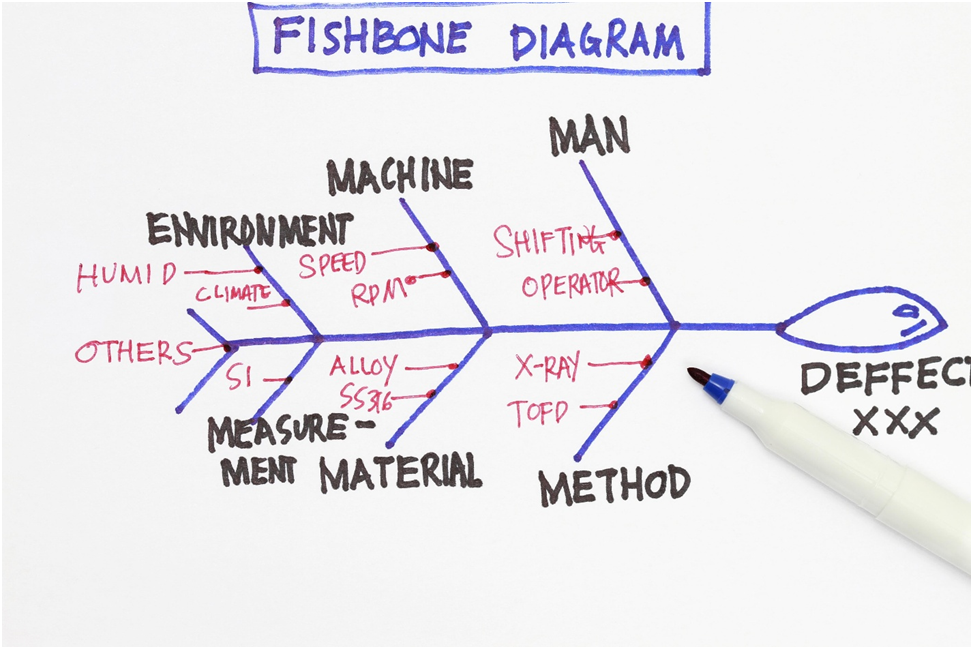
- Operationalized Application (In an Incident Report): “The immediate cause of the amputation was the operative bypassing the machine interlock. However, the subsequent Root Cause Analysis utilizing the Ishikawa (Fishbone) diagram identified a systemic organizational failure: production targets were increased by 15% without a commensurate increase in staffing, creating an environment where supervisory staff tacitly encouraged the overriding of safety systems to maintain operational throughput.”
Terminology Set 5: Management of Change and Performance (LO9 & LO10)
Understanding Management of Change (MOC) and evaluating safety performance indicators define strategic safety leadership.
8. Management of Change (MOC)
- Academic Definition: A systematic approach to dealing with the transition or transformation of an organization’s goals, processes, or technologies.
- UK Legal Context: Vital for ensuring that safety arrangements under HASAWA 1974 remain valid when the operational environment shifts.
- Operationalized Application (In a Corporate Policy): “The installation of the new robotic welding cells constitutes a significant operational shift. Consequently, a formal Management of Change (MOC) protocol is hereby initiated. The system cannot go live until a cross-functional operational readiness review confirms that the new electrical load requirements, altered site traffic routes, and updated operator training matrices have been fully evaluated and secured against existing risk parameters.”
9. Leading vs. Lagging Indicators
- Academic Definition: Lagging indicators measure past outcomes (like accident rates). Leading indicators measure proactive activities that prevent accidents (like training hours).
- UK Legal Context: HSE guidance strongly encourages the use of leading indicators to demonstrate active management of health and safety, moving beyond mere compliance-based reporting.
- Operationalized Application (In a Board-Level Safety Dashboard): “While our Total Recordable Incident Rate (a Lagging Indicator) has remained static this quarter, our primary focus is driving an upward trend in our Leading Indicators. By mandating an increase in executive safety walk-arounds and significantly reducing the closure time for Corrective and Preventive Actions (CAPA), we are proactively dismantling risk environments before they manifest as recordable injuries.”
B. Learner Task
Target Unit: ACAI0005-1: Health and Safety Management System (HSMS)
Aligned Learning Outcome:
LO6: Design and implement hazardous energy control programs covering electrical, hydraulic, thermal, kinetic, mechanical, and magnetic energy sources.
Required Evidence from Assessment Plan:
Lockout/Tagout (LOTO) procedure manual.
The Scenario
You are the Lead Safety Engineer at a UK-based heavy manufacturing plant that produces stamped steel automotive components. Next month, the facility is taking delivery of a new, complex 1000-ton hydraulic stamping press. This machine possesses immense hazardous energy: a 415V electrical supply, high-pressure hydraulic accumulators, and significant kinetic energy when the massive steel ram is in motion.
In preparation for the installation and future maintenance of this press, you must draft the core operational protocol for the facility’s new safety manual.
Task Instructions
Your task is to author a highly technical, UK-compliant excerpt for the Lockout/Tagout (LOTO) procedure manual specifically governing the safe maintenance of the new 1000-ton hydraulic stamping press.
You must step out of the “student” mindset and act as the definitive authority. You are not defining terms; you are embedding them into a strict procedure to control liability and protect your technicians.
Within your manual excerpt, you must successfully operationalize the following five terms:
- Zero Energy State
- Positive Isolation
- Hierarchy of Hazard Control
- Dissipation (of residual energy)
- As Low As Reasonably Practicable (ALARP)
Strict Formatting and Length Constraint:
To demonstrate your ability to write concisely and definitively in a highly regulated environment, the written response for your assignment must be exactly 350 words.
C. Submission Guidelines
To ensure your assessment meets the rigorous quality assurance standards of the ICTQual AB, you must adhere strictly to the following submission and formatting protocols:
- Submission Method: All portfolio evidence must be uploaded directly via the official learner portal. Email submissions directly to assessors are not permitted.
- File Format: Your evidence must be submitted exclusively in PDF or a high-quality scanned format.
- Naming Convention: A clear naming convention is required for document tracking. Please use the following structure: Unit1_YourName_LOTOProcedureManual.
- Authentication: Documents must be dated, clearly labelled with the relevant unit and learning outcome, and authenticated. You are responsible for maintaining confidentiality regarding any simulated corporate data used within your submission.
- Referencing Requirements: When citing external sources, legislation, or internal technical manuals using the Harvard referencing style, you must add fictional dates (e.g., 2024, 2025) to any reference where a specific publication date is not originally mentioned.
- No Undated References: You must actively ensure the complete removal of “(n.d.)” from all Harvard-style references within your portfolio.