
Guide to Understanding and Completing HSMS Concept-to-Practice Handouts
Health and Safety Management System (HSMS)
Introduction
This Knowledge Provision Task (KPT) is designed for candidates undertaking the ICTQual Level 8 Professional Diploma in Health, Safety and Environmental Engineering. Operating at a strategic Level 8 standard requires practitioners to bridge the gap between complex health and safety theory and tangible, frontline operational execution. This Concept-to-Practice Handout is formulated to demonstrate exactly how advanced risk management principles, international frameworks, and UK regulatory mandates translate into daily workplace actions and engineering safety protocols.
As a senior health, safety, and environmental (HSE) engineering professional, your role extends beyond mere compliance; you are expected to design, lead, and evaluate dynamic safety systems. This comprehensive guide provides assessor-prepared notes that dissect core HSMS principles and explicitly link them to vocational workplace realities. You will use this detailed operational context to complete your evidence-based assessment.
A. Knowledge Guide: Concept-to-Practice Handout
This section maps core safety concepts and regulatory expectations directly to vocational workplace applications, ensuring you understand how to implement theoretical frameworks in high-risk engineering and industrial environments.
Concept 1: Internationally Recognized HSMS Frameworks
The Concept:
A Health and Safety Management System (HSMS), such as ISO 45001 or ANSI Z10, provides a structured, internationally recognized framework for managing occupational health and safety risks. These systems operate on the Plan-Do-Check-Act (PDCA) continuous improvement cycle, demanding strong leadership commitment, worker consultation, and systematic risk mitigation to enhance overall safety performance.
Workplace Practice:
Imagine you are overseeing a large-scale civil engineering firm in the UK. Implementing ISO 45001 does not mean just writing a policy; it requires operational integration.
- Plan: You conduct baseline audits of all construction sites, identifying risks like heavy plant machinery movement and working at heights. You set a strategic objective to reduce site transport incidents by 20% over 12 months.
- Do: You implement a new traffic management system, create designated pedestrian walkways with physical barriers, and train all site operatives on the new protocols.
- Check: You conduct weekly site inspections and review incident/near-miss reports to monitor the effectiveness of the new traffic management system.
- Act: If inspections reveal that contractors are occasionally bypassing walkways, you update the site induction process and enforce stricter supervisory oversight to address the behavioral gap.
Concept 2: UK Legal Frameworks and Compliance
The Concept:
In the United Kingdom, workplace safety is governed by robust legislative frameworks. The primary statute is the Health and Safety at Work etc. Act 1974 (HASAWA), which places a general duty on employers to ensure the health, safety, and welfare of their employees and others affected by their activities. This is supported by the Management of Health and Safety at Work Regulations 1999 (MHSWR), which legally mandates the execution of suitable and sufficient risk assessments.
Workplace Practice:
In a UK-based heavy manufacturing facility, HASAWA 1974 dictates that the employer must provide a safe working environment. MHSWR 1999 puts this into action.
- If your facility utilizes a CNC milling machine, the MHSWR requires you to document a specific risk assessment for its operation.
- If the assessment identifies a risk of entanglement or ejection of metal swarf, the law requires you to implement controls.
- Failing to document this assessment or failing to maintain the machine’s interlock guards is not just a policy breach; it is a criminal offense under UK law, leaving the organization and its directors liable for prosecution by the Health and Safety Executive (HSE).
Concept 3: The Hierarchy of Hazard Control
The Concept:
The hierarchy of hazard control is a fundamental safety principle used to eliminate or minimize workplace risks. It prioritizes control measures from the most highly effective (elimination) to the least effective (Personal Protective Equipment – PPE).
Workplace Practice:
Consider a construction project involving the cutting of concrete, which generates hazardous respirable crystalline silica (RCS) dust.
- Elimination: Can we order pre-cut concrete blocks to site, eliminating the need for on-site cutting entirely?
- Substitution: If cutting is required, can we use a different building material that does not contain silica?
- Engineering Controls: If we must cut concrete, we use a saw fitted with a local exhaust ventilation (LEV) system or a water-suppression attachment to capture or dampen the dust at the source.
- Administrative Controls: We limit the time any single worker spends cutting concrete to reduce their overall exposure duration, and we implement strict exclusion zones around the cutting area.
- PPE: As a final layer of defense, the worker is issued a properly face-fitted FFP3 respirator. PPE is only relied upon after all preceding controls have been applied.
Concept 4: Advanced Risk Analysis Techniques (FMEA & FTA)
The Concept:
Advanced hazard identification goes beyond standard risk assessments. Techniques like Failure Modes and Effects Analysis (FMEA) systematically evaluate how a process or product might fail and the impact of that failure. Fault Tree Analysis (FTA) uses a top-down, logical diagram to trace the root causes of a specific unwanted event.
Workplace Practice:
You are the safety engineer for an automated chemical packaging plant.
- Using FMEA: You analyze the conveyor system. A “Failure Mode” might be a sensor malfunction. The “Effect” could be chemical bottles colliding and spilling. You score this based on severity, occurrence, and detectability, realizing that the sensor needs a redundant backup system to prevent a highly toxic spill.
- Using FTA: You start with the “Top Event”: A chemical reactor over-pressurization. You work downwards using logic gates. Why did it happen? Either the pressure relief valve failed OR the temperature control system malfunctioned. If the temperature control failed, why? Because the cooling water pump failed AND the backup generator didn’t start. This allows you to pinpoint exact points of vulnerability in complex engineering systems.
Concept 5: Hazardous Energy Control (LOTO)
The Concept:
Hazardous energy control programs are vital for preventing the unexpected release of energy (electrical, mechanical, hydraulic, pneumatic, thermal, or kinetic) during equipment maintenance or servicing. This is typically managed through strict Lockout/Tagout (LOTO) procedures.
Workplace Practice:
A maintenance technician needs to repair a heavy industrial hydraulic press.
- Turning off the control panel switch is insufficient. The technician must completely isolate the machine from its power sources.
- They physically disconnect the electrical supply and place a standardized padlock on the breaker (Lockout).
- They apply a warning tag with their name, date, and reason for the lockout (Tagout).
- Crucially, they must also bleed off any residual hydraulic pressure trapped in the lines to neutralize stored energy. Only when all energy is isolated, locked, tagged, and verified (by attempting to start the machine) can the technician safely enter the point of operation to perform repairs.
Concept 6: Globally Harmonized System (GHS) and Chemical Safety
The Concept:
The Globally Harmonized System of Classification and Labelling of Chemicals (GHS) ensure consistent chemical hazard communication worldwide. It relies on standard pictograms, signal words, hazard statements, and comprehensive Safety Data Sheets (SDS).
Workplace Practice:
A facility receives a new industrial degreaser.
- The HSE manager reviews the SDS provided by the manufacturer. The SDS indicates the chemical is a severe skin irritant and highly flammable.
- The manager ensures the container displays the correct GHS pictograms (the flame symbol and the exclamation mark symbol).
- Based on the GHS data, the manager updates the COSHH (Control of Substances Hazardous to Health) assessment. They mandate that the degreaser must be stored in a specialized, fire-rated, ventilated cabinet, away from oxidizing agents, and that operatives must wear specific nitrile gauntlets and splash goggles during use.
Concept 7: Incident Investigation and Root Cause Analysis
The Concept:
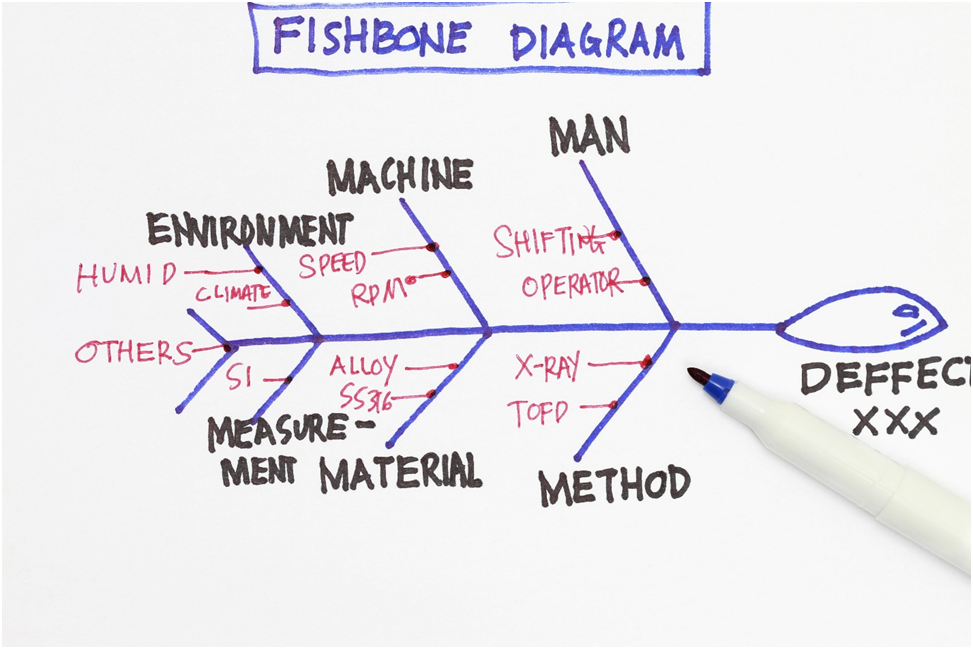
When accidents occur, investigations must move beyond identifying immediate causes (e.g., “the worker slipped”) to uncovering systemic root causes (e.g., “why was there a leak, and why was it not cleaned up?”). This involves evidence collection, data analysis, and developing Corrective and Preventive Actions (CAPA).
Shutterstock
Workplace Practice:
A forklift truck strikes a structural support column in a warehouse.
- Immediate Action: The area is secured, and the driver is medically evaluated.
- Investigation: The safety manager collects evidence: photographs of the skid marks, the forklift’s maintenance log, and witness statements.
- Root Cause Analysis: Using a technique like the “5 Whys,” the manager discovers the immediate cause was the driver losing control on a wet floor. Why was it wet? A roof leak. Why was it leaking? Scheduled maintenance was deferred. Why was it deferred? Budget cuts in the facilities department.
- CAPA: The corrective action is not just to retrain the driver or mop the floor; it is to immediately repair the roof and revise the organizational budget approval process for critical facility maintenance to prevent future hazards.
Concept 8: Safety Performance Indicators
The Concept:
Evaluating safety performance requires a balance of lagging and leading indicators. Lagging indicators measure past failures (incident rates), while leading indicators measure proactive activities taken to prevent incidents.
Workplace Practice:
If a company only tracks the number of injuries (a lagging indicator), they only know they have a problem after people get hurt. A competent Level 8 professional will establish a dashboard of leading indicators. For example, tracking the percentage of management safety walkarounds completed on schedule, the number of hazard reports submitted by frontline workers, and the average closure time for corrective actions. If hazard reporting drops and corrective action closure times extend, the safety manager knows risk is increasing and can intervene before an actual injury occurs.
B. Learner Task
Target Unit:
Unit ACAI0005-1: Health and Safety Management System (HSMS)
Aligned Learning Outcome:
LO2: Apply the hierarchy of hazard control measures to eliminate or minimize workplace risks and improve organizational safety performance.
Required Evidence from Assessment Plan:
Risk control plan applying elimination, substitution, engineering controls, administrative controls, and PPE.
The Scenario
You are the Lead Safety Engineer at a UK-based heavy fabrication facility. A new operational process has been introduced: the manual arc welding of large galvanized steel beams. During the initial trial phase, workers reported significant exposure to welding fumes (which can contain harmful metal oxides), intense ultraviolet (UV) arc radiation, and elevated noise levels from nearby grinding activities.
Senior management has halted the process and tasked you with developing a comprehensive, documented strategy to protect the workforce before production can resume.
Task Instructions
You must produce a Risk control plan applying elimination, substitution, engineering controls, administrative controls, and PPE.
Your plan must systematically address the hazards of the new galvanized steel welding process. For your submission, you must structure your response strictly around the hierarchy of control, providing a specific, vocational application for each level of the hierarchy to mitigate the identified hazards (fumes, UV radiation, noise).
Ensure your proposed controls are realistic for a UK fabrication environment and align with standard HSE expectations for managing respiratory and physical hazards.
Constraint: You must synthesize your risk control plan clearly and concisely. Your submitted response for this task must be exactly 350 words.
C. Submission Guidelines
To ensure your portfolio evidence is successfully processed and graded, please adhere strictly to the following assessment procedures:
- Submission Portal: All assessments must be submitted through the online portfolio system via the official learner portal.
- File Format: Your evidence must be submitted in PDF or a high-quality scanned format.
- Naming Convention: You must use the following clear naming convention for your file: Unit1_YourName_RiskControlPlanEvidence
- Document Standards: Ensure your document is dated, clearly labelled with the unit reference, and authenticated. You must ensure your unit references and learning outcomes are clearly identified within the text.
- Assessment Feedback: Once submitted, written feedback will be provided via the learner dashboard. If your assessor marks the task as “Not Yet Competent (NYC),” you may resubmit your revised evidence. The standard resubmission timeframe is 10-14 working days.