
Foundations of Health, Safety & Environmental Engineering Concepts
Foundations of Health, Safety, and Environmental Engineering
Purpose
The Concept Explainer Sheet is designed to simplify and clarify complex HSE theories for learners, enabling them to:
- Understand fundamental HSE principles in engineering contexts
- Apply theory to practical workplace situations
- Critically analyse risks, human factors, and environmental impacts
- Develop strategic, Level 7 decision-making skills
- Use examples and visuals to consolidate learning
Section 1: Hierarchy of Risk Control
Theory Simplified:
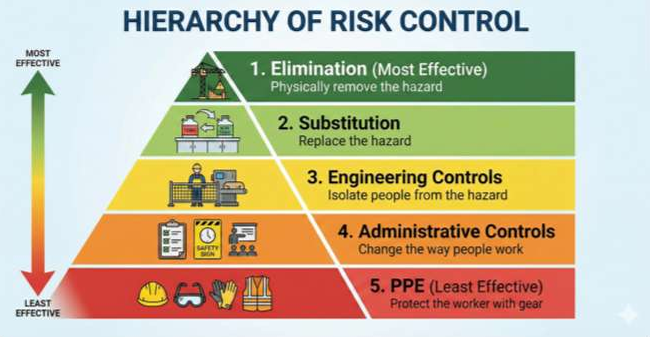
The Hierarchy of Risk Control is a structured framework for reducing workplace risks, prioritising control measures based on effectiveness, from most to least effective. It is widely used in UK HSE practice and ensures risk reduction is ALARP (As Low As Reasonably Practicable).
Hierarchy Steps:
- Elimination: Remove the hazard entirely. Example: Replace solvent-based paints with water-based paints to eliminate chemical inhalation risk.
- Substitution: Replace the hazard with something less harmful. Example: Using low-noise machinery to reduce hearing damage risk.
- Engineering Controls: Isolate the hazard using technology or design. Example: Enclosure of moving machinery parts or ventilation systems.
- Administrative Controls: Implement safe procedures, training, schedules, and supervision.
- Personal Protective Equipment (PPE): Last line of defense. Example: Helmets, gloves, eye protection.
Workplace Scenario Example:
- Scenario: Welding in a confined space.
- Application:
o Elimination: Off-site fabrication instead of on-site welding
o Engineering: Local exhaust ventilation
o Administrative: Work permit system, training
o PPE: Respiratory protection, fire-resistant clothing
Visual:
Analytical Questions:
- Explain why PPE is the least effective control in the hierarchy.
- How does applying the hierarchy reduce the likelihood of chemical exposure incidents?
- Identify the stage often overlooked in engineering projects and justify why it is critical.
Section 2: Human Factors in HSE
Theory Simplified:
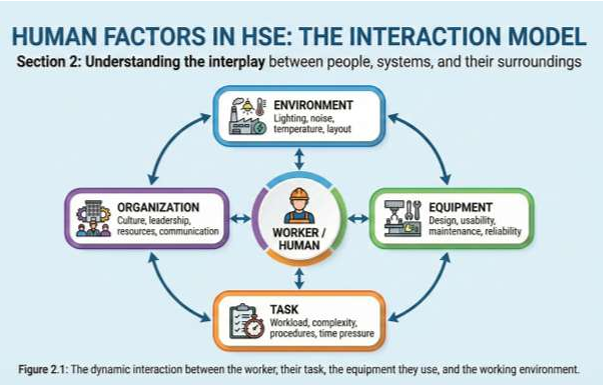
Human factors are behavioural, psychological, and physiological elements that influence safety outcomes. They are critical in engineering HSE as they directly affect decision-making and operational safety.
Key Considerations:
- Fatigue and shift patterns
- Stress, workload, and pressure
- Communication and teamwork
- Training and competence
- Workplace culture
Workplace Scenario Example:
- Scenario: Operators fatigue on a 12-hour shift at a chemical plant.
- Impact: Increased risk of errors in chemical dosing.
- Mitigation: Implement shift rotations, fatigue monitoring, and supervision.
Visual:
Analytical Questions:
- How can fatigue and stress lead to near misses?
- Which strategies can reduce human error in high-risk engineering operations?
- Explain how human factors interact with technical hazards during risk assessment.
Section 3: Environmental Impact Assessment (EIA)
Theory Simplified:
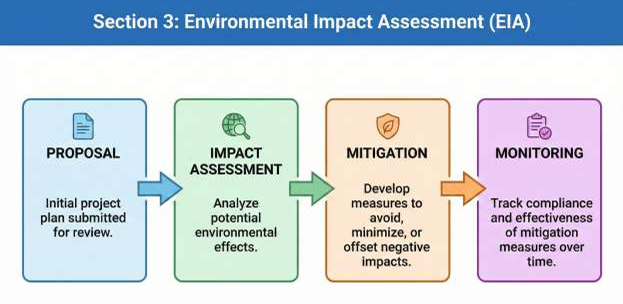
EIA evaluates potential environmental effects before starting an engineering project. It ensures environmental protection and compliance with Environmental Protection Act 1990 and related UK legislation.
Stages of EIA:
- Project proposal
- Impact identification (air, water, soil, ecosystems)
- Risk assessment
- Mitigation planning
- Monitoring and review
Workplace Scenario Example:
- Scenario: Construction of a petrochemical plant near a water body.
- Mitigation Measures: Dust suppression, wastewater treatment, noise barriers
Visual:
Analytical Questions:
- How does EIA support compliance with UK Environmental Law?
- Identify key environmental risks for high-rise construction and propose mitigations.
- How does EIA influence strategic HSE decision-making at project level?
Section 4: Accident Causation Models
Theory Simplified:
Accident causation models explain why incidents occur, enabling proactive safety strategies. They include:
- Heinrich’s Domino Theory: Unsafe acts → Accident → Injury
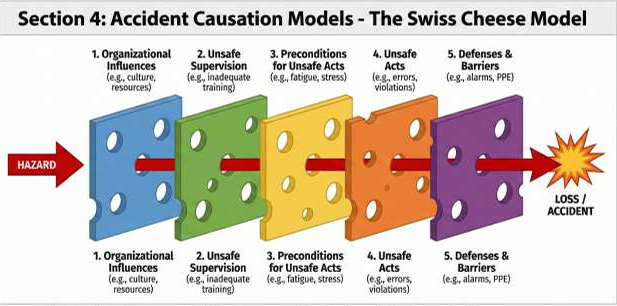
- Swiss Cheese Model (Reason): Accidents occur when multiple barrier failures align
- Bowtie Analysis: Threats, preventive barriers, mitigative controls
Workplace Scenario Example:
- Scenario: Forklift collision due to machinery fault (technical) and poor training (human).
- Application: Swiss Cheese Model identifies layers of protection and gaps.
Visual:
Analytical Questions:
- Compare Heinrich and Swiss Cheese models in risk prevention.
- How can Bowtie Analysis prevent chemical storage accidents?
- Which model best supports Level 7 strategic planning and why?
Section 5: ALARP Principle in Risk Management
Theory Simplified:
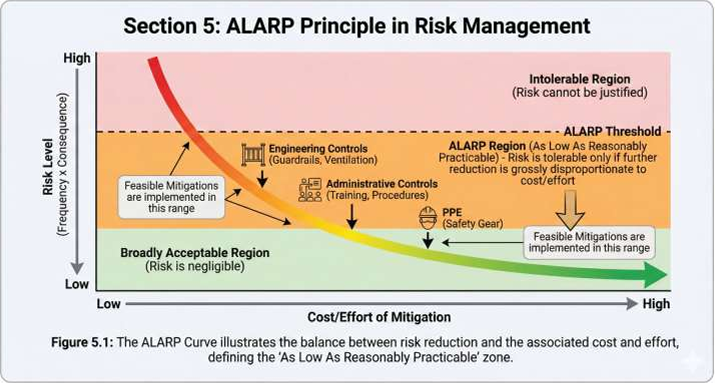
ALARP – As Low As Reasonably Practicable – ensures risks are reduced proportionally to effort and cost, achieving safe and feasible solutions.
Workplace Scenario Example:
- Insulation of high-temperature pipes to prevent burns
- Confined space entry audits to ensure worker safety
Visual:
Analytical Questions:
- How do you decide when a risk is ALARP in a complex project?
- Provide an example where cost limitations affect ALARP decisions.
- How does ALARP relate to compliance with Health & Safety at Work Act 1974?
Section 6: Integrated Workplace Application
Task:
Learners combine all concepts in a practical case study:
Scenario:
- Construction of a chemical processing unit.
- Hazards: High-pressure systems, chemical spills, working at height, noise exposure.
Stepwise Application:
- Apply Hierarchy of Risk Control to each hazard
- Consider Human Factors in work scheduling and training
- Conduct EIA for emissions and waste
- Apply Accident Causation Models for potential incidents
- Ensure ALARP compliance in all mitigation strategies
Analytical Questions:
- Prioritize the five concepts in terms of strategic HSE impact and justify.
- Which concept would most effectively prevent major incidents?
- How would you communicate these strategies to stakeholders and ensure compliance?
Section 7: Learner Task
Instructions:
- Complete the concept worksheets with workplace examples
- Draw diagrams/visuals for each concept
- Answer all analytical questions with detailed reasoning
- Provide a reflective commentary (1500 words):
- How these concepts improve risk mitigation and compliance
- How understanding these theories enhances HSE leadership at Level 7
Expected Evidence:
- Completed Concept Explainer Sheets with visual
- Analytical answers with workplace application
- Reflective commentary demonstrating strategic understanding