
Turning Energy Management Concepts into Practice: A Guide for Learners
Technical and Operational Energy Management
Purpose
The purpose of this handout is to link theoretical concepts in energy management to real-world workplace applications. Learners will be able to:
- Identify energy systems, equipment, and operational processes across industrial, commercial, and residential sectors
- Apply technical upgrades, operational adjustments, and behaviour-based measures to optimise energy performance
- Analyse energy consumption patterns to pinpoint inefficiencies and cost-saving opportunities
- Demonstrate practical energy management competence while ensuring compliance with UK energy regulations
This handout is designed with vocational focus, highlighting decision-making, tool use, and operational strategies in real workplaces.
Section 1: Core Energy Concepts and Practical Applications
| Concept | Definition | Practical Application | Workplace Example | Regulatory Reference (UK) |
| Energy Audit | A systematic examination of energy use to identify inefficiencies | Measure consumption of machinery, lighting, and HVAC; identify high-energy processes | Sub-metering production lines in a factory to detect overconsumption | Energy Savings Opportunity Scheme Regulations 2014 |
| Load Profiling | Recording and analysing energy usage over time to detect peaks and inefficiencies | Collect hourly/daily electricity data to determine peak demand | Warehouse identifies peak compressor usage at night and adjusts scheduling | Building Regulations Part L |
| Preventative Maintenance | Routine servicing of equipment to maintain efficiency and reduce breakdowns | Inspect and clean boilers, motors, pumps, and HVAC units | Quarterly inspection of industrial boilers to ensure optimal combustion | Health & Safety at Work Act 1974 |
| Technical Upgrades / Retrofits | Replacing outdated equipment with more efficient alternatives | Install LED lighting, VSD motors, or efficient chillers | Replacing old fluorescent lights with LED in offices | Building Regulations Part L |
| Behavioural Practices | Staff actions that affect energy use | Train employees to switch off idle machines and computers | Office staff reduce unnecessary lighting and equipment use | SECR Reporting Guidance |
| Sub-Metering | Monitoring energy use at system, department, or process level | Install sub-meters to track energy per production line | Detect which machines consume the most energy | ESOS compliance |
| HVAC Optimisation | Adjusting heating, ventilation, and cooling to match operational needs | Set HVAC to maintain target temperature range, apply night setbacks | Offices maintain 19–21°C instead of 24°C constantly | Building Regulations Part L |
| KPI Monitoring | Measuring energy performance against set targets | Use energy dashboards to monitor kWh per machine or department | Alerts for abnormal energy consumption | SECR Regulations |
| Renewable Energy Integration | Using solar, wind, or biomass to offset grid consumption | Install rooftop solar panels or solar water heating | Factory reduces grid electricity by 25% via PV panels | Building Regulations Part L |
| Equipment Scheduling | Planning operational hours to reduce peak demand and energy cost | Stagger start times for machinery to avoid simultaneous peak | Compressor and motor schedules adjusted to off-peak hours | SECR energy efficiency guidance |
Section 2: Detailed Workplace Scenario Examples
Scenario 1: Industrial Plant Motor Efficiency
- Concept Applied: Variable speed drives (VSD) and preventative maintenance
- Action: Replace fixed-speed motors with VSD motors; conduct monthly motor bearing inspections
- Impact: Reduces energy consumption by 20% and prevents unplanned downtime
- Regulatory Alignment: ESOS requires identifying inefficient equipment
Scenario 2: Office Lighting Upgrade
- Concept Applied: Technical Upgrade / Retrofit
- Action: Replace fluorescent tubes with LED lights; install occupancy sensors in conference rooms
- Impact: Reduces lighting energy consumption by 40%; decreases operational cost
- Regulatory Alignment: Building Regulations Part L sets energy efficiency standards for buildings
Scenario 3: Compressed Air Leak Management
- Concept Applied: Load profiling, sub-metering, and preventative maintenance
- Action: Use ultrasonic detectors to locate leaks; repair leaks; monitor compressor energy usage
- Impact: Reduces electricity consumption for compressors by 15–25%
- Regulatory Alignment: ESOS compliance mandates energy efficiency assessment
Scenario 4: Behavioural Energy Savings
- Concept Applied:Behavioural practices and KPI monitoring
- Action: Train staff to switch off idle equipment; monitor dashboard to reinforce compliance
- Impact: Reduces non-essential electricity consumption by 5–10%
- Regulatory Alignment: SECR reporting requires initiatives for organisational energy reduction
Scenario 5: Boiler Efficiency in Manufacturing
- Concept Applied: Preventative maintenance, monitoring, and operational adjustment
- Action: Regular cleaning of heat exchangers; adjust combustion air and fuel ratio
- Impact: Improves boiler efficiency by 8–10%; reduces fuel cost and carbon emissions
- Regulatory Alignment: Health & Safety at Work Act 1974 ensures safe operation
Section 3: Step-by-Step Concept-to-Practice Workflow
- Identify the energy system or process
- Measure baseline energy consumption using meters, sub-meters, or dashboards
- Detect inefficiency or abnormal energy usage
- Apply appropriate technical, operational, or behavioural measures
- Monitor the result over a defined period (e.g., monthly)
- Adjust operations or schedule preventative maintenance as needed
Example Workflow:
- Step 1: Compressed air system in a factory
- Step 2: Sub-meter records 1000 kWh/month
- Step 3: Ultrasonic leak detector finds 150 kWh loss
- Step 4: Repair leaks and adjust pressure settings
- Step 5: Monitor usage next month → 850 kWh
- Step 6: Schedule quarterly leak inspections
Section 4: Energy Analysis Techniques
| Technique | Purpose | Vocational Example |
| Sub-Metering | Detect inefficiency at equipment or department level | Track energy per production line in a factory |
| Load Profiling | Identify peak demand and optimize operations | Determine peak compressor usage in warehouse |
| KPI Monitoring | Track energy use against targets | Dashboard alerts for overconsumption |
| Benchmarking | Compare energy use to industry standards | Compare kWh per unit of output to similar factories |
| Root Cause Analysis | Investigate abnormal energy consumption | Identify why HVAC consumes excess electricity |
Section 5: UK Regulatory and Compliance Context
| Task | Relevant UK Legislation | Practical Implication |
| Energy Audit | Energy Savings Opportunity Scheme Regulations 2014 | Mandatory energy assessment for large companies |
| KPI Monitoring | Streamlined Energy and Carbon Reporting Regulations 2018 | Accurate monitoring ensures compliant reporting of energy use and carbon |
| Preventative Maintenance | Health & Safety at Work Act 1974 | Equipment must be maintained to reduce energy waste and safety risks |
| Lighting and HVAC Upgrades | Building Regulations Part L | Minimum energy efficiency requirements for new or retrofitted systems |
Section 6: Practical Vocational Tips
- Target high-energy systems first: Boilers, compressors, motors, and HVAC units
- Combine technical upgrades with behavioural changes: Maximum impact on energy efficiency
- Use data to prioritise interventions: Sub-metering and dashboards are essential
- Document all improvements: For compliance, auditing, and management reporting
- Evaluate return on investment (ROI): Focus on upgrades with shortest payback periods first
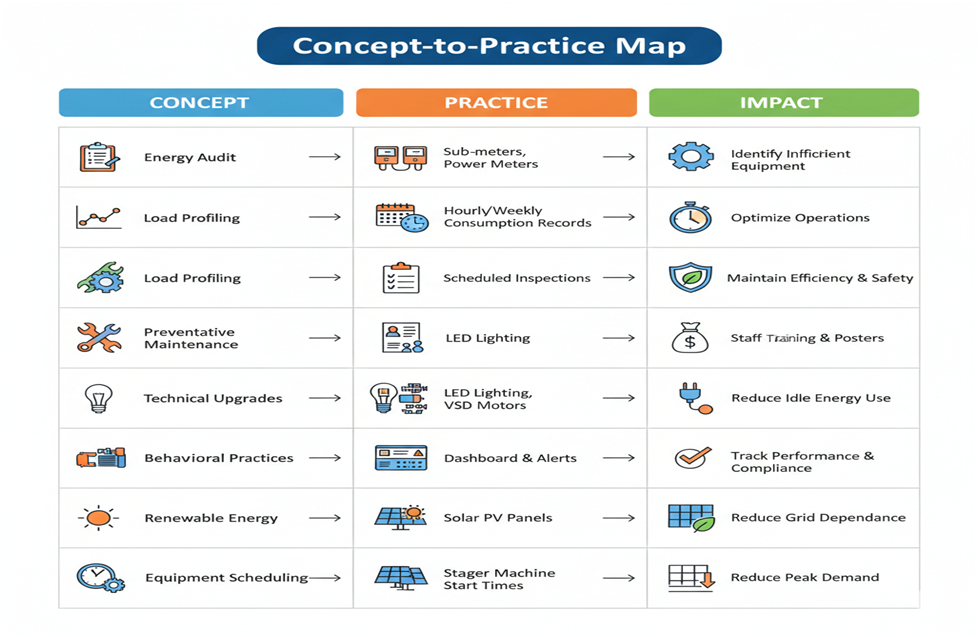
Section 7: Visual Aid – Concept-to-Practice Map
Learner Task
Instructions:
- Select three workplace scenarios (industrial, commercial, or residential).
- For each scenario:
- Identify the key energy concept applied
- Describe the technical or operational action taken
- Explain the expected energy and cost savings
- Reference one relevant UK regulation or standard
- Include practical justification for each action, demonstrating your understanding of vocational application