
Level 3 Energy Management: Apply Key Terms in Practice
Introduction to energy management
Purpose
This activity focuses on developing learners’ practical competency by linking energy management terminology to the correct tools, equipment, or materials used in real workplace tasks. Unlike a glossary, this task forces learners to make strategic decisions about the appropriate application of terms in operational scenarios.
Key objectives:
- Build tool and equipment awareness in energy-related tasks
- Develop decision-making skills for selecting correct materials or instruments
- Reinforce practical vocational competence in workplace energy management
- Connect theoretical knowledge to real, hands-on applications
Section 1: Core Energy Management Terms and Their Application
The table below presents key terms, their function, and typical tools/materials required for workplace tasks.
| Term | Function / Description | Example Tool / Material |
| Energy Audit | Identify areas of energy loss and inefficiency | Handheld power meter, sub-metering kit |
| Lighting Retrofit | Replace inefficient lighting | LED bulbs, ladder, screwdriver |
| Compressed Air Leak Detection | Detect leaks in piping and systems | Ultrasonic leak detector |
| HVAC Efficiency Check | Assess heating, ventilation, and AC systems | Anemometer, thermometer, pressure gauge |
| Sub-Meter Installation | Measure energy use per system or area | Electrical sub-meter, wiring kit |
| Boiler Efficiency Assessment | Evaluate boiler energy performance | Flue gas analyser, temperature probe |
| Renewable Energy Installation | Set up PV panels or wind systems | Solar panels, inverter, mounting kit |
| Behavioural Campaign | Encourage staff to conserve energy | Posters, digital dashboard, email notifications |
| KPI Monitoring | Track energy performance metrics | Energy management software, spreadsheet dashboard |
| Safety Compliance Check | Ensure operations meet HSE and UK regulations | PPE, safety signage, checklist forms |
Section 2: Job Scenario Matching
Instructions:
- For each task below, select the correct tool or material from the options provided. Each task may have more than one correct choice, but learners must justify the selection.
Scenario Tasks:
- Task: Conduct an energy audit in a medium-sized office building.
- Options:
A. Ultrasonic leak detector
B. Handheld power meter
C. LED light bulbs
D. Ladder
- Options:
- Task: Replace old halogen lights with energy-efficient alternatives.
- Options:
A. LED bulbs
B. Ladder
C. Pressure gauge
D. Solar inverter
- Options:
- Task: Identify leaks in a compressed air network in a factory.
- Options:
A. Ultrasonic leak detector
B. Handheld power meter
C. Behavioural posters
D. Flue gas analyser
- Options:
- Task: Measure electricity consumption per production line.
- Options:
A. Sub-meter
B. Flue gas analyser
C. Energy dashboard software
D. PPE kit
- Options:
- Task: Monitor and track energy KPIs for monthly reporting.
- Options:
A. Energy management software
B. Ladder
C. Temperature probe
D. Solar panel kit
- Options:
- Task: Conduct a boiler efficiency assessment in a small industrial plant.
- Options:
A. Flue gas analyser
B. Pressure gauge
C. Handheld power meter
D. Behavioural campaign materials
- Options:
- Task: Promote energy-saving behaviours among office staff.
- Options:
A. Posters and email notifications
B. Ultrasonic leak detector
C. LED bulbs
D. Sub-meter
- Options:
Section 3: Practical Application Guidance
For each scenario, learners should:
- Identify the task correctly
- Select the correct tool/material based on task requirements
- Justify the selection in 1–2 sentences
- Optionally, link the selection to UK energy regulations or standards, e.g., SECR or ESOS, when monitoring, auditing, or reporting is involved
Example:
- Task: Conduct energy audit
- Selection: Handheld power meter
- Justification: Used to measure the electrical consumption of individual circuits to identify inefficiency; supports SECR compliance reporting
Section 4: Regulatory Context
Learners should understand that proper tool selection is not only a competency issue but also a regulatory requirement in the UK:
| Task Type | Relevant UK Regulation | Compliance Implication |
| Energy audit | Energy Savings Opportunity Scheme Regulations 2014 | Audit results must identify inefficiencies and potential energy savings |
| KPI monitoring | Streamlined Energy and Carbon Reporting Regulations 2018 | Accurate monitoring ensures compliant energy reporting |
| Boiler efficiency | Health & Safety at Work Act 1974 | Correct measurement tools prevent unsafe operations and ensure efficiency |
Section 5: Visual Aid – Tool-to-Task Mapping
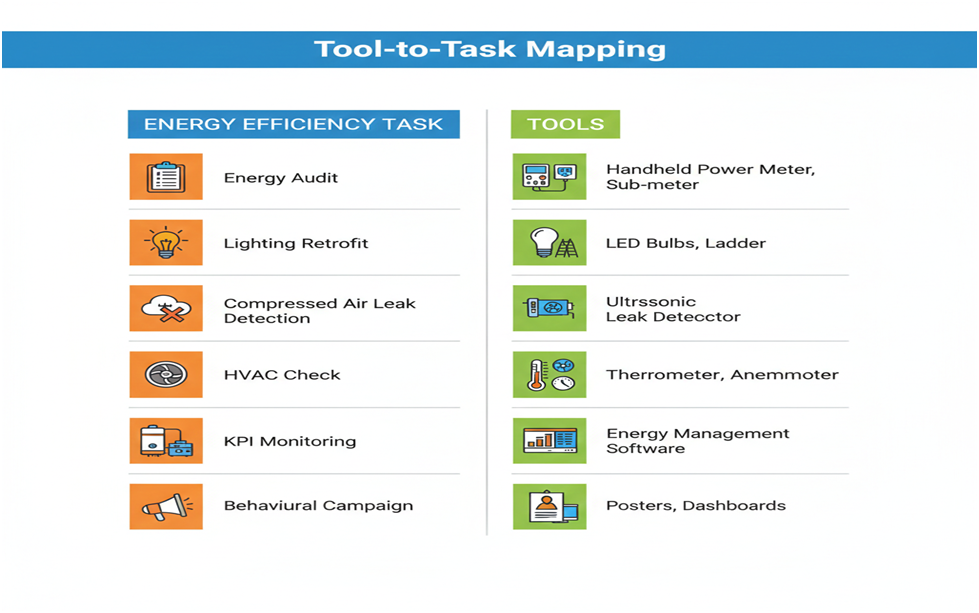
Learner Task
From the scenarios above:
- Select any three tasks.
- Identify the correct tool or material required for each.
- Justify your selection in 1–2 sentences per task.
- Include one relevant UK regulation or guideline linked to each task.