
Separate Facts from Misconceptions in Electrical QA/QC – Level 6
Electrical Project Planning, Risk, and Compliance Management
Introduction
Welcome to the Knowledge Providing Task for the ICTQual AB Level 6 Diploma in Quality Assurance and Quality Control (QA/QC) Electrical. This specific document focuses on advanced competency within project planning, risk evaluation, and compliance management. At this senior level, professionals are expected to move beyond simply identifying technical faults; you must critically evaluate systemic management approaches, strategic scheduling, and resource allocation. The focus here is on identifying and dismantling deeply ingrained industry fallacies that compromise electrical safety, project viability, and legal compliance. True competency requires a shift from reactive operational checking to proactive, strategic risk management that influences overall project culture and commercial outcomes.
Purpose of Activity
The core objective of this activity is the critical analysis of professional fallacies. You are required to stop looking at simple true or false scenarios. Instead, you will dissect dangerous assumptions and false economies that cause systemic management failures in electrical projects. By performing root cause analyses on why these myths persist at the management level, you will evaluate their long-term strategic and financial consequences. This directly aligns with applying advanced project planning techniques, interpreting UK electrical regulations, and evaluating the effectiveness of risk management frameworks.
Concept Explainer Sheet
Understanding Systemic False Economies
A “False Economy” in electrical QA/QC occurs when a management decision saves time or resources in the short term but results in disproportionately higher costs, legal liabilities, or catastrophic failures in the long term. These are not simple wiring errors made by a technician; they are strategic failures in project planning and risk management.
- Operational Error: A technician fails to properly torque a termination on a distribution board.
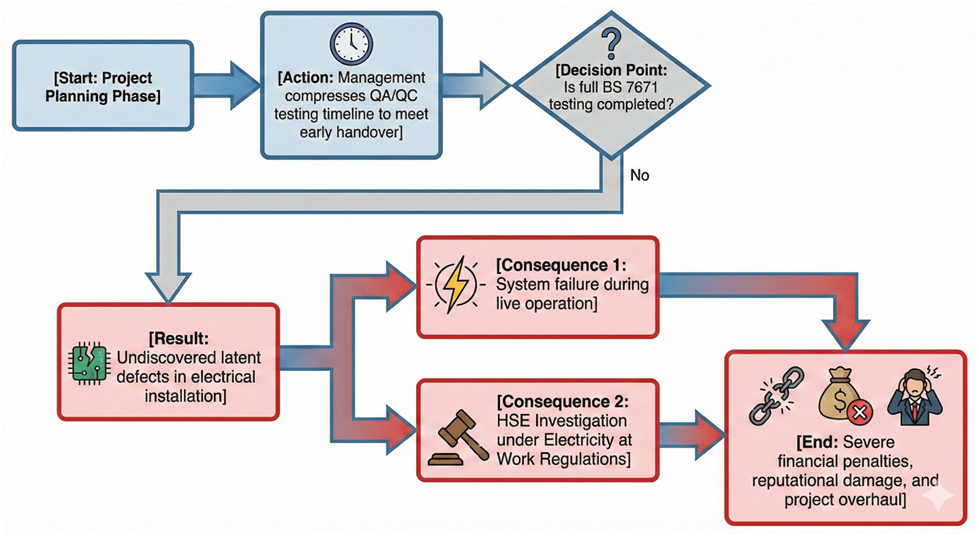
- Systemic Failure (The Myth): Management allocates only half the required hours for the final testing and inspection phase to accelerate project handover, assuming that a rapid visual check is sufficient.
- The Competency Gap: Failing to integrate robust QA/QC processes into the core project schedule out of fear that it will delay progress.
Flow Diagram: The Anatomy of a Systemic Failure
Analyzing Common Myths
In the electrical construction and QA/QC sector, several pervasive myths dictate poor management behavior. These myths often masquerade as “industry standard practices” or “commercial realities.” As a Level 6 candidate, you must possess the professional judgment to challenge these fallacies using evidence-based risk management and rigorous planning adaptation.
- The belief that minimum compliance equals optimal safety.
- The assumption that QA/QC is a separate phase rather than an integrated process.
- The fallacy that risk transfer to subcontractors absolves the main entity of regulatory responsibility.
Myth One Analysis
“QA/QC Slows Project Progress”
This is perhaps the most dangerous systemic management failure in the industry. Project managers often view Quality Assurance and Quality Control as adversarial to project scheduling. They operate under the fallacy that integrating comprehensive QA/QC processes will inherently delay electrical installations. Therefore, testing, inspection, and compliance monitoring are often relegated to the very end of the project, treated as a final hurdle rather than an ongoing, integrated resource allocation.
Root Cause Analysis:
Why does this myth persist? It stems from a fundamental misunderstanding of advanced project planning techniques. Traditional Gantt charts often isolate testing from installation. When project budgets tighten or timelines slip due to early-stage delays, the testing and commissioning phase is the first to be compressed. Management mistakenly equates “hours spent testing” with “hours lost.” There is a systemic failure to understand that finding a defect during first-fix installation costs exponentially less to rectify than finding it during final commissioning.
Strategic Financial Consequences:
The long-term impact of this myth is devastating. Bypassing integrated QA/QC leads to high rework rates. In the UK, rectifying non-compliant electrical work post-installation involves not only labor and material costs but also severe disruption to the client. The financial consequences stretch into the millions of pounds when considering delayed facility opening times, voided warranties, and potential breaches of the Electricity at Work Regulations 1989. The strategic damage to a company’s reputation often excludes them from future high-value tenders.
Myth Two Analysis
“Code Minimum Equals Safety”
Another persistent fallacy is the belief that designing and inspecting an electrical system strictly to the minimum baseline of national codes is sufficient for complex, high-risk environments. Management teams often push back against QA/QC recommendations that exceed minimum regulatory standards, citing unnecessary expenditure.
Root Cause Analysis:
- This myth is driven by aggressive cost-engineering and a commoditized view of electrical installations. Decision-makers often lack the technical competency to understand that documents like BS 7671 (IET Wiring Regulations) provide the minimum requirements for safety, not necessarily the optimum requirements for system resilience, longevity, or specific operational risks. This represents a failure to effectively identify and evaluate risks associated with specific, complex electrical installations.
Strategic Financial Consequences:
- Systems built strictly to minimum compliance often lack flexibility and resilience. In a commercial environment, this leads to premature system obsolescence. A minor operational change by the client may overload a minimally compliant system, leading to power outages, data loss, and massive business interruption costs. The financial burden of retrofitting an inadequate system far outweighs the initial investment in robust, above-minimum QA/QC and design standards.
Myth Three Analysis
“Subcontractors Hold All Risk”
Many principal contractors operate under the false economy that by sub-contracting electrical work, they entirely transfer the associated risks and compliance obligations. They assume their internal QA/QC oversight can be minimal because the sub-contractor is contractually bound to deliver a compliant system.
Root Cause Analysis:
This persists due to a severe misinterpretation of legal and regulatory obligations in the UK. Under the Construction (Design and Management) Regulations 2015 (CDM 2015), accountability cannot be entirely delegated. Principal contractors maintain a statutory duty to monitor compliance and ensure competent management of the project. The failure here is a lack of integration of QA/QC processes into the overarching project management framework, leading to a blind spot regarding subcontractor performance.
Strategic Financial Consequences:
When an electrical failure occurs, or a fatal incident happens due to poor subcontractor work, the Health and Safety Executive (HSE) will investigate the principal contractor’s oversight mechanisms. If the principal contractor cannot provide comprehensive compliance monitoring logs and evidence of an active risk management framework, they face catastrophic legal action. The financial consequences include unlimited fines, potential imprisonment for directors, and the complete collapse of the organization.
Overcoming Fallacies Strategically
To dismantle these myths, senior QA/QC professionals must utilize advanced project planning techniques to make quality an undeniable, visible metric. This requires a cultural shift from reactive fault-finding to proactive risk mitigation. You must learn to speak the language of project managers and commercial directors, translating technical electrical risks into financial and strategic impacts.
- Develop integrated schedules where QA/QC milestones are hard-linked to project progress payments.
- Implement mandatory hold points that prevent the continuation of work until specific compliance checks are verified.
- Utilize risk assessment matrices to visually demonstrate to stakeholders the probability and severe impact of bypassing quality protocols.
Learner Evidence Task
Evidence Required:
Risk Management Framework Evaluation
Contextual Scenario:
You are the senior QA/QC lead taking over a delayed commercial hospital wing project in the UK. The previous management team operated under the false economy that integrating continuous QA/QC would inherently delay electrical installations. As a result, they relegated testing to the final phase, assuming minimum compliance with national codes would suffice. You must formally evaluate their flawed framework and document the systemic failures before implementing a proactive, integrated risk strategy.
Task Instructions:
Develop a comprehensive Risk Management Framework Evaluation that critically analyzes the systemic management failures of the previous project team.
- Step 1: Identify and document at least three systemic failures in the previous management’s approach to QA/QC scheduling and risk evaluation, specifically addressing the myth that QA/QC is a separate phase rather than an integrated process.
- Step 2: Evaluate the long-term strategic and financial consequences of these failures, including potential breaches of the Electricity at Work Regulations 1989.
- Step 3: Analyze the gap between their code minimum approach and the actual rigorous requirements of the BS 7671 IET Wiring Regulations for a complex, high-risk hospital environment.
- Step 4: Detail how their failure to actively monitor subcontractor compliance violates the statutory duties and accountability required by the Construction Design and Management Regulations 2015.
- Step 5: Conclude the evaluation with authoritative recommendations on how the risk management framework must be restructured to embed mandatory hold points and continuous compliance monitoring into the project lifecycle.
Submission Guidelines QA/QC
To successfully complete this task, you must adhere to the following strict submission parameters:
- The final submission must be a comprehensive professional document focusing entirely on vocational application and competency, rather than academic theory.
- Ensure all references to laws, regulations, and safety standards are strictly applicable to the United Kingdom.
- Your work must reflect the high-level critical thinking expected of a Level 6 candidate, demonstrating your ability to recommend corrective actions and monitor compliance with legal obligations.
- Ensure the formatting presents a clear, professional standard suitable for review by senior management.