
Topic Briefing Sheet: Electrical Project Compliance & Risk Management – Level 6
Electrical Project Planning, Risk, and Compliance Management
Introduction
The electrical engineering sector demands rigorous oversight, precision, and an unwavering commitment to safety and operational excellence. This specific component of the ICTQual AB Level 6 Diploma in Quality Assurance and Quality Control (QA/QC) Electrical focuses entirely on the critical phases of project planning, proactive risk management, and stringent compliance monitoring within complex electrical installations. As a senior professional overseeing large-scale industrial and commercial electrical projects, it is evident that successful execution relies not on theoretical memorization, but on the practical application of advanced management techniques. This section sets the foundation for applying high-level strategic oversight to electrical QA/QC activities, ensuring that every phase of an installation aligns with statutory requirements and industry best practices. Zero academic theory. 100% workplace application.
- Establishes the foundational requirements for advanced QA/QC electrical project management.
- Focuses on the practical execution of complex electrical installations in commercial environments.
- Emphasizes the critical nature of aligning project timelines with robust quality assurance protocols.
- Requires the demonstration of professional judgment and complex decision-making in real-world scenarios.
- Highlights the necessity of integrating continuous monitoring mechanisms into daily site operations.
Purpose Of Task
The primary objective here is to validate your competency in translating strategic project goals into actionable, compliant, and risk-resilient electrical operations. At a Level 6 standard, the expectation moves far beyond basic operational tasks; you are required to demonstrate authoritative control over project variables, ensuring that all QA/QC processes are seamlessly integrated into the broader project schedule. This involves evaluating the effectiveness of existing frameworks, identifying critical compliance gaps before they escalate, and recommending decisive corrective actions. The ultimate goal is to prove your capability to safeguard project integrity, optimize resource allocation, and enforce adherence to the most current national regulatory standards without compromising project delivery timelines.
- Validates advanced competency in electrical QA/QC project planning and risk mitigation.
- Ensures the practical application of professional judgment to resolve complex site challenges.
- Confirms the ability to integrate quality control milestones seamlessly into master project schedules.
- Demonstrates capability in identifying, evaluating, and neutralizing high-impact electrical risks.
- Proves proficiency in enforcing statutory compliance and regulatory obligations across all site activities.
Concept Explainer Sheet
Navigating the complexities of electrical QA/QC requires a deep understanding of core project management and risk mitigation concepts. This sheet provides clarity on the pivotal frameworks you must master to effectively manage high-stakes electrical projects. Risk evaluation in this context involves systematically identifying potential hazards within electrical installations, assessing their probability, and determining their potential impact on both safety and project delivery. Compliance management is the continuous process of ensuring that all materials, methodologies, and final installations meet stringent legal requirements. Resource allocation within QA/QC dictates how specialized personnel and testing equipment are deployed across the project lifecycle to maintain quality standards without causing operational bottlenecks. Understanding these concepts interactively is crucial for senior-level oversight.
- Risk Mitigation Matrix: A structured tool used to evaluate the severity and likelihood of electrical hazards, prioritizing workplace interventions.
- Compliance Monitoring: The ongoing, systematic review of site activities to guarantee alignment with legal and contractual obligations.
- Corrective Action Strategies: Definitive, documented steps taken to rectify identified non-conformances and prevent their recurrence.
- QA/QC Integration: The strategic embedding of inspection and testing milestones into the primary construction scheduling.
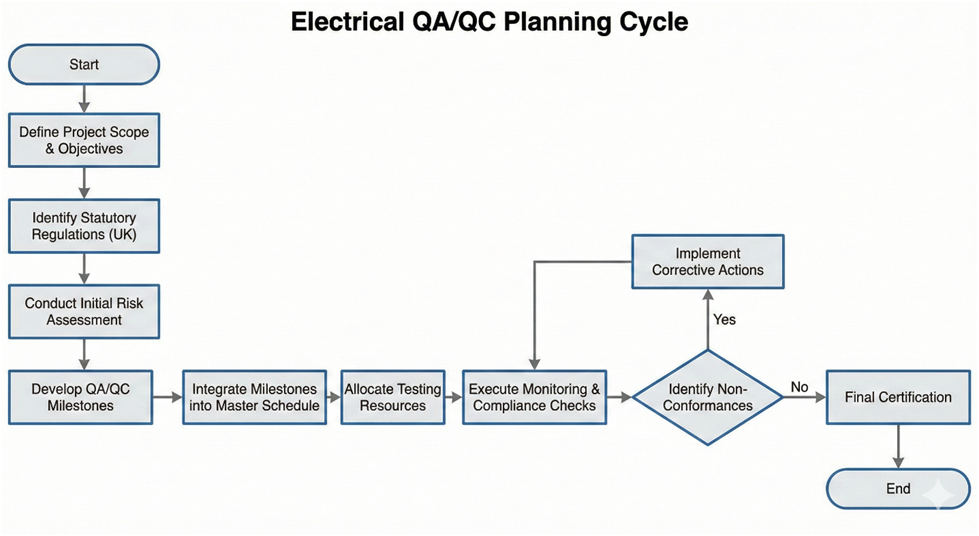
Topic Briefing Notes
Effective electrical project planning requires a comprehensive integration of quality assurance directly into the operational timeline. At this advanced professional level, planning is not merely about scheduling; it is about strategically positioning QA/QC hold points to verify that all work meets the exact specifications required by UK statutory frameworks. This includes strict adherence to BS 7671 (IET Wiring Regulations), the Electricity at Work Regulations 1989, and the Health and Safety at Work etc. Act 1974. Failure to interpret and apply these national codes correctly can result in severe legal and operational consequences. Therefore, project schedules must reflect a deep understanding of these regulations, ensuring that adequate time and resources are allocated for comprehensive testing, inspection, and certification processes before systems are energized.
Risk management frameworks must be continuously evaluated for their effectiveness. An electrical installation presents unique hazards, ranging from arc flashes to systemic overloading, which require advanced mitigation strategies. Your professional judgment is critical in analyzing these risks, anticipating potential interaction effects between different electrical systems, and deploying proactive measures. When compliance gaps are identified during routine monitoring, you must be capable of recommending and enforcing immediate corrective actions. This involves not only fixing the immediate issue but also analyzing the root cause to prevent future deviations. Resource allocation must also be optimized, ensuring that qualified inspectors and calibrated testing equipment are available precisely when needed, preventing costly delays while maintaining an uncompromising stance on quality and safety. Zero academic theory. 100% workplace application.
- Requires mastery of BS 7671 to ensure all electrical installations meet current UK wiring regulations.
- Demands strict compliance with the Electricity at Work Regulations 1989 to maintain workplace safety.
- Necessitates the strategic placement of QA/QC inspection milestones within the master project timeline.
- Involves the continuous evaluation of site-specific risk management frameworks to adapt to evolving hazards.
- Requires the ability to conduct root cause analyses and implement robust corrective action plans for compliance gaps.
- Focuses on the efficient allocation of specialized QA/QC resources to prevent project bottlenecks.
Learner Task Assignment
You have been appointed as the lead QA/QC electrical manager for a newly constructed, multi-story commercial office complex in central London. During the initial phases of the electrical installation, you identify a significant compliance gap regarding the routing of high-voltage containment systems near critical communication infrastructure, which poses both a severe operational risk and a direct violation of current UK wiring regulations. Your task is to utilize your professional judgment to address this critical issue while minimizing disruption to the overall project schedule. You must formulate a comprehensive, workplace-ready strategy that identifies the specific risks, details the regulatory breaches, and provides a clear, actionable plan to resolve the situation effectively.
- Develop a detailed Risk Mitigation Strategy Document to address the identified containment routing issue.
- Ensure the document explicitly references relevant UK regulations, including BS 7671 and the Electricity at Work Regulations 1989.
- Outline the specific, step-by-step corrective actions required to rectify the compliance gap on-site.
- Detail how you will allocate necessary resources to implement the mitigation strategy without derailing the project timeline.
- Demonstrate complex decision-making and practical competency; zero academic theory is permitted.
- Focus strictly on the singular evidence type required, ensuring it meets the highest standards of professional workplace documentation.
Task Submission Guidelines
To successfully complete this module, your documentation must reflect the standards expected of a senior professional operating at Level 6 within the QA/QC electrical sector. The submitted work must be impeccably structured, technically accurate, and completely aligned with the specified qualification standards. It is imperative that your strategy demonstrates a practical, real-world approach to problem-solving, showcasing your ability to navigate complex workplace challenges while maintaining strict regulatory compliance. Ensure that your formatting is professional, clear, and directly addresses the requirements outlined in the task assignment.
- Submit the required document in a clear, professional, and easily readable format.
- Ensure all regulatory references are strictly limited to UK national codes and standards.
- Verify that the content is a mix of concise paragraphs and well-structured bullet points.
- Confirm that the submission focuses entirely on workplace application and professional competency.
- Review the document to guarantee no irrelevant data or external qualification references are included.
- Ensure the final submission reflects the highest level of technical accuracy and strategic planning.