
Electrical QA/QC: Using Concept Explainer Sheets Effectively
Electrical Project Planning, Risk, and Compliance Management
Introduction
Welcome to this critical phase of your vocational development. As a senior professional with two decades of hands-on experience in the electrical sector, I have designed this document to guide your progression through the ICTQual AB Level 6 Diploma in Quality Assurance and Quality Control (QA/QC) Electrical. Moving beyond basic textbook theory, this phase of your career requires deep competency, sharp professional judgment, and the ability to make complex decisions under pressure. You are no longer just learning about quality control; you are preparing to lead it, direct it, and take full accountability for electrical project outcomes in demanding, real-world environments.
To achieve this level of mastery, you must shift your perspective from academic memorization to practical implementation. The industry demands leaders who can seamlessly integrate quality assurance protocols directly into the lifeblood of project schedules, rather than treating them as an afterthought. This requires a robust understanding of site dynamics, resource allocation, and the real-time challenges that arise during large-scale installations. By engaging with this material, you will refine your ability to anticipate issues before they manifest into costly delays or critical failures.
- You will develop the professional judgment required to oversee complex electrical installations while maintaining strict adherence to quality standards.
- Your competency in applying advanced planning techniques will be challenged and elevated to meet senior-level industry expectations.
- The focus remains entirely on vocational application, ensuring your skills translate directly to active construction and engineering sites.
- You will learn to navigate the intricacies of stakeholder communication, ensuring that all teams understand their role in maintaining project integrity.
Purpose Of Explainer
The primary objective of this Concept Explainer Sheet is to simplify difficult theories and translate them into actionable, site-ready strategies for your current unit: Electrical Project Planning, Risk, and Compliance Management. We are breaking down high-level project management methodologies so that you can directly apply them to QA/QC activities on complex electrical projects. This is about equipping you with the analytical tools needed to evaluate risk management frameworks and recommend precise corrective actions when deviations occur.
Your success at the Level 6 standard hinges on your ability to interpret and enforce rigorous standards without compromising project timelines or budget constraints. This document serves as a bridge between theoretical risk models and the gritty reality of site management. It is structured to force you to think critically about how every regulatory requirement impacts daily operations and long-term project viability. You are expected to absorb these concepts and immediately reflect on how they alter your approach to managing teams, resources, and legal obligations.
- To clarify the integration of quality processes into broader project scheduling and resource allocation frameworks.
- To establish a clear understanding of how to monitor compliance with contractual and legal obligations effectively.
- To provide visual and practical examples that simplify complex risk evaluation and mitigation strategies.
- To prepare you for the complex decision-making required when addressing compliance gaps in the field.
Advanced Project Planning
In the realm of electrical installations, advanced project planning is the foundation upon which all quality assurance rests. A plan that lacks embedded quality control milestones is essentially a roadmap to failure. When you map out an electrical project, you must account for the specific timing of inspections, testing procedures, and resource availability required for these critical checks. This means your scheduling tools must reflect the dual reality of physical installation and rigorous verification, ensuring that neither process bottlenecks the other.
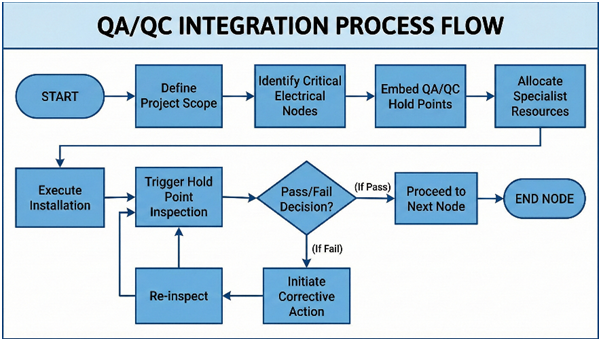
Understanding how to allocate resources effectively is a cornerstone of this competency. You cannot simply assign a general workforce to perform highly specialized QA/QC checks; you must strategically schedule certified personnel to align with your project milestones. This foresight prevents the common industry pitfall of having construction teams sitting idle while waiting for an overbooked inspector to arrive on site. Effective planning anticipates these constraints and builds realistic buffers into the project timeline.
- QA/QC milestones must be treated as hard constraints within your scheduling framework, requiring explicit sign-off before subsequent phases commence.
- Resource allocation must dynamically adjust to the specific competency levels required for different stages of electrical testing and commissioning.
- Advanced planning requires the continuous evaluation of site progress against the baseline schedule to proactively address potential quality compromises.
- You must demonstrate professional judgment when adapting plans to unforeseen site conditions while maintaining absolute adherence to quality standards.
Electrical Risk Evaluation
Risk in our sector extends far beyond physical hazards; it encompasses the systemic failure of quality controls that can lead to catastrophic operational or legal consequences. Identifying and evaluating these risks requires a proactive mindset, analyzing the interaction between different electrical systems and the environments in which they operate. You must look beyond the immediate installation and consider the entire lifecycle of the system, evaluating how environmental factors, user interaction, and material degradation might compromise the integrity of the project over time.
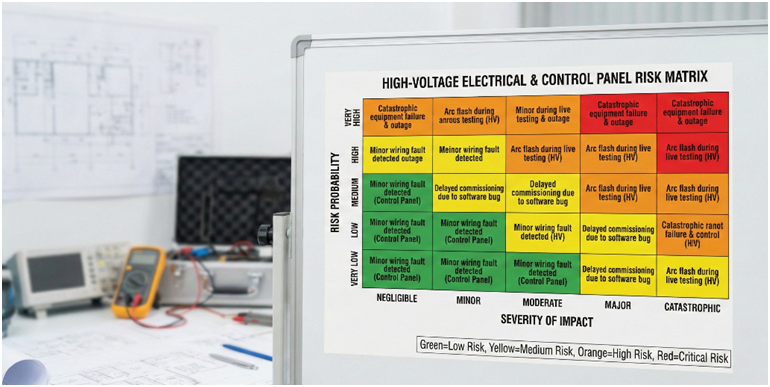
Evaluating the effectiveness of risk management frameworks is an ongoing responsibility for a Level 6 practitioner. You must scrutinize existing protocols to determine if they are genuinely mitigating risks or merely creating an illusion of safety through excessive paperwork. This involves a deep dive into root cause analysis when near-misses or quality deviations occur, using these events as critical data points to strengthen the overall risk profile of the project. Your objective is to foster a culture where risk identification is encouraged and actively managed at all levels of the project team.
- Risk matrices must be customized to reflect the specific technical parameters and operational environments of the electrical systems being installed.
- Continuous evaluation of risk interaction is mandatory, as the mitigation of one risk can sometimes inadvertently elevate another.
- Your professional judgment is critical in determining the acceptable threshold for residual risks after mitigation strategies have been fully implemented.
- Evaluating framework effectiveness requires analyzing historical project data to identify recurring failures in quality control processes.
UK Compliance Management
Navigating the legal and regulatory landscape is perhaps the most critical competency for an electrical professional operating in the UK. Your work must be entirely underpinned by strict adherence to the BS 7671 IET Wiring Regulations, the Electricity at Work Regulations 1989, and the broader Health and Safety at Work Act 1974. Interpreting these codes is not a passive exercise; you must actively translate these complex legal texts into clear, executable instructions for your site teams. Failure to enforce these standards represents a fundamental breach of your professional duty and carries severe legal and contractual repercussions.
Monitoring compliance requires a systematic approach to auditing and documentation. You must implement robust tracking mechanisms that provide transparent, irrefutable evidence that all regulatory obligations have been met at every stage of the project. When compliance gaps are identified, your response must be immediate and decisive. Recommending corrective actions is not enough; you must oversee their implementation and verify their effectiveness, ensuring that the root cause of the non-compliance has been permanently eradicated from the project workflow.
- Thorough comprehension and application of BS 7671 are non-negotiable for ensuring the safety and legality of all electrical installations.
- Compliance monitoring must be continuous, utilizing comprehensive logs and checklists to track adherence to both national codes and specific contractual obligations.
- Corrective actions must be evidence-based, addressing the systemic failures that allowed the compliance gap to occur in the first place.
- You must maintain meticulous records of all regulatory applications and inspections to protect the project from future legal or contractual disputes.
Candidate Task Requirements
To demonstrate your competency in this unit, you are required to produce highly detailed, professional-grade documentation that reflects the realities of a complex electrical project. This task will test your ability to synthesize planning, risk, and compliance into a cohesive, actionable format. You must approach this assignment with the rigor and precision expected of a senior QA/QC professional, ensuring that every detail aligns strictly with the standards set forth by the ICTQual AB Level 6 Diploma in Quality Assurance and Quality Control (QA/QC) Electrical.
EVIDENCE GENERATION REQUIREMENT:
- Compliance Checklists (National & International Codes)
Contextual Scenario:
You are overseeing the electrical installation phase of a large-scale commercial office fit-out in central London. The project includes high-capacity server room power distribution, complex lighting control systems, and general power circuits. As the senior QA/QC professional, you must ensure that all installations strictly adhere to UK legal and regulatory frameworks before any system is energized.
Task Execution:
Develop a comprehensive set of Compliance Checklists (National & International Codes) to be used by your site inspection teams.
- Step 1: Create specific checklist sections for the server room power distribution, lighting control systems, and general power circuits.
- Step 2: For each section, embed explicit inspection points derived directly from BS 7671 IET Wiring Regulations.
- Step 3: Integrate verification checks that ensure compliance with the Electricity at Work Regulations 1989 and the broader Health and Safety at Work Act 1974. Focus specifically on safe isolation procedures, testing protocols, and earthing arrangements.
- Step 4: Include designated sign-off areas for the inspector, the installation supervisor, and the final QA/QC authorization.
- Step 5: Provide a brief introductory guideline for your site team explaining how to use the checklist to document non-conformances and trigger immediate corrective actions.
Submission Guidelines:
Your final submission must be a polished, professional document ready for immediate deployment on a live construction site.
- Ensure your writing is concise, authoritative, and strictly focused on vocational application.
- The document structure must clearly delineate between the different electrical systems being inspected.
- Proofread your work to guarantee absolute technical accuracy regarding UK regulations and codes.
- Submit the completed Compliance Checklists (National & International Codes) as a standard PDF document.