
Applying Legal Frameworks in Energy Management: The Role of Key Law & Regulation Summary Sheets
Technical and Operational Energy Management
Purpose
This sheet is designed to give learners a vocational understanding of UK legislation,regulations, and standards that govern energy management in industrial, commercial, and residential settings. Learners will see how laws translate into practical actions and operational compliance.
Objectives:
- Ensure learners can identify relevant UK energy legislation
- Apply regulations to real workplace decisions
- Understand compliance implications for technical upgrades, operational changes, and energy monitoring
- Promote safe, sustainable, and cost-effective energy management practices
Section 1: Core UK Energy Laws and Regulations
| Legislation / Standard | Purpose / Summary | Workplace Implications | Example of Vocational Application |
| Energy Savings Opportunity Scheme (ESOS) Regulations 2014 | Requires large organisations to carry out energy audits every four years to identify energy efficiency opportunities | Mandatory auditing of high-energy systems such as boilers, HVAC, and production equipment | A manufacturing plant conducts a sub-metered audit of all compressors and motors to identify efficiency improvements |
| Streamlined Energy & Carbon Reporting (SECR) Regulations 2018 | Requires large UK companies to report annual energy use, emissions, and efficiency measures | Monitoring of energy consumption through KPIs and dashboards; documentation of savings | A commercial office building reports electricity and gas consumption annually and implements LED retrofits based on the data |
| Health & Safety at Work Act 1974 | Ensures safe operation of energy systems and equipment | Maintenance schedules must be applied to prevent hazards and energy waste | Regular inspection and servicing of boilers and pressure systems to avoid inefficiency and unsafe operation |
| Building Regulations Part L (Conservation of Fuel and Power) | Sets minimum energy performance standards for buildings and systems | Technical upgrades for lighting, HVAC, insulation, and building controls must meet efficiency targets | Retrofitting LED lighting and installing smart HVAC controls in offices to comply with Part L |
| The Energy Performance of Buildings (England and Wales) Regulations 2012 | Requires EPC ratings for buildings and mandates operational energy performance measures | Facilities managers must maintain high EPC ratings and reduce building energy use | Upgrading boilers, insulation, and HVAC controls in commercial buildings to improve EPC ratings |
| Electricity Safety, Quality and Continuity Regulations 2002 | Ensures electricity systems are safe, reliable, and efficient | Prevents electrical hazards while optimising energy usage | Routine inspection of distribution boards and transformer efficiency testing |
| Carbon Reduction Commitment Energy Efficiency Scheme (CRC, now integrated into SECR) | Encouraged large organisations to measure and improve energy efficiency and reduce carbon emissions | Monitoring energy use, reporting carbon footprint, and implementing efficiency measures | Installing energy dashboards and sub-meters to track electricity consumption in factories |
| ISO 50001 – Energy Management Systems (EMS) | International standard adopted in the UK for establishing energy management processes | Organisation-wide monitoring and continuous improvement of energy performance | Implementing ISO 50001 processes in industrial plants to track consumption, set KPIs, and ensure operational compliance |
Section 2: Key Regulations and Technical Implications in Practice
Energy Audits (ESOS)
- Vocational Focus: Identify high-energy equipment such as motors, compressors, chillers
- Implementation: Sub-metering, energy logs, inspection schedules
- Operational Impact: Enables prioritisation of energy-saving interventions and ROI calculations
Energy Reporting (SECR)
- Vocational Focus: Monitor electricity, gas, and fuel usage via dashboards
- Implementation: Set departmental KPIs, track energy consumption trends
- Operational Impact: Supports budgeting, cost allocation, and compliance reporting
Building Energy Efficiency (Part L)
- Vocational Focus: Upgrade lighting, HVAC, insulation, and building controls
- Implementation: Retrofit LED lights, install smart thermostats, optimise heating schedules
- Operational Impact: Reduces utility bills, supports compliance, improves occupant comfort
Health & Safety in Energy Operations
- Vocational Focus: Prevent accidents and unsafe practices affecting energy efficiency
- Implementation: Scheduled maintenance, safety inspections, risk assessments
- Operational Impact: Reduces downtime, prevents energy waste, ensures regulatory compliance
ISO 50001 (Energy Management Systems)
- Vocational Focus:Formalise energy management processes
- Implementation: KPI dashboards, monitoring tools, continuous improvement cycles
- Operational Impact: Tracks energy performance over time, enables systematic operational improvements
Section 3: Case Study – Industrial Plant Compliance
Scenario:
- A medium-sized factory with high electricity and gas consumption.
Applicable Legislation:
- ESOS – mandatory energy audit
- SECR – energy reporting requirements
- Health & Safety at Work Act – equipment safety
Practical Actions:
- Conducted sub-metered energy audit to identify inefficient compressors and HVAC units (ESOS compliance)
- Installed KPI dashboards to monitor monthly energy consumption (SECR compliance)
- Implemented preventative maintenance schedules for boilers and motors (Health & Safety compliance)
- Retrofitted lighting to LED and added occupancy sensors (Building Regulations Part L compliance)
Impact:
- Energy consumption reduced by 15% in six months
- Operational cost savings realised
- Documentation ready for SECR and ESOS submission
Section 4: Vocational Application Workflow
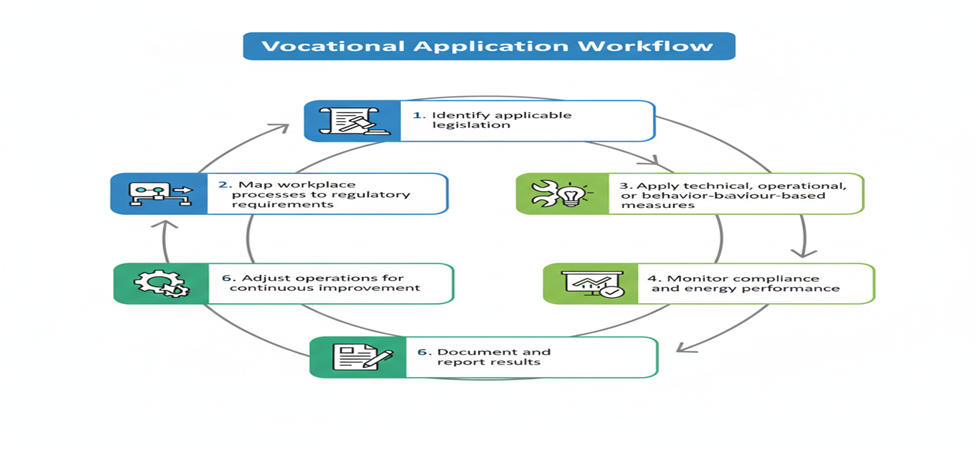
Example:
- Step 1: SECR reporting
- Step 2: Map electricity meters and fuel usage across departments
- Step 3: Install energy dashboard and sub-meters
- Step 4: Monitor monthly kWh against targets
- Step 5: Submit annual SECR report
- Step 6: Adjust lighting schedules and boiler operation to reduce energy
Section 5: Practical Vocational Tips
- Integrate legislation into daily operations – don’t treat compliance as paperwork only
- Use data to demonstrate compliance – sub-meters and dashboards simplify reporting
- Link operational efficiency to legal requirements – maintenance schedules, system upgrades, and staff training
- Document all energy-saving interventions – crucial for audits, inspections, and SECR reporting
- Regularly review regulatory updates – energy legislation is periodically amended
Section 6: Visual Aid – Regulatory Compliance Map
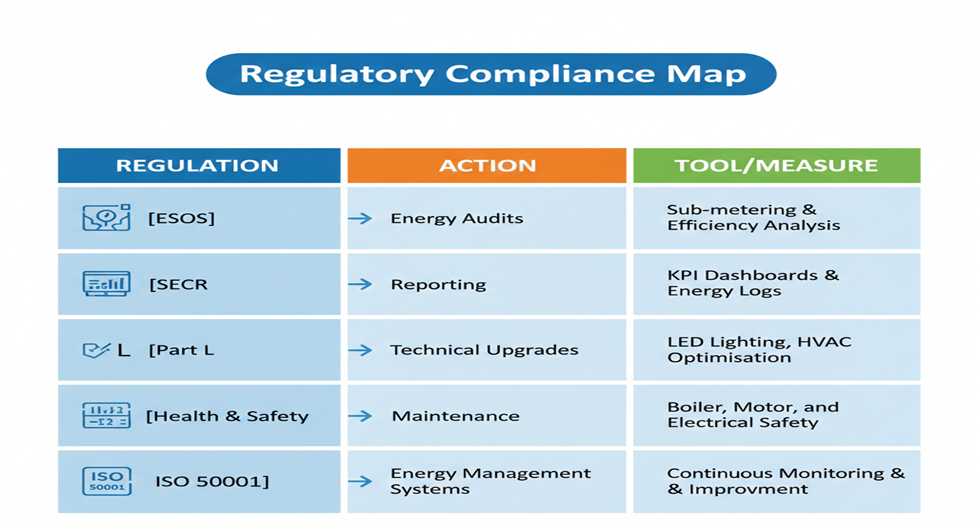
Learner Task
Instructions:
- Choose three UK energy regulations from the table above.
- For each regulation:
- Describe its purpose
- Identify practical workplace measures to comply with it
- Provide a vocational example of how it would be implemented in an industrial, commercial, or residential setting
- Include references to real equipment, processes, or monitoring tools used